Anonymous chat: what the word covers, and what it hides
Anonymous chat means the person you are talking to learns nothing about you beyond what you choose to type. On that measure, the one everybody actually means, this is fully anonymous: no real name, no account, no profile, nothing anyone can look up afterwards. Type a nickname above for free text or voice chat, 18 and over. The rest of this page explains the word properly, because almost nobody does.
Anonymous to whom? That is the whole question
Two completely different questions hide inside this one word, and mixing them up is how the marketing on every site in this category gets away with saying so little. The first is what the stranger on the other side can learn about you. The second is what any website receives simply because you opened it. They are not the same thing, they do not have the same answer, and only the first is what people mean when they type anonymous chat into a search box, and it is the one an anonymous chat should be judged on.
On the first question, the answer here is straightforwardly yes. There is no real name, no email, no phone number, no social login and no profile page, so the person you are matched with sees a nickname you invented and the words you decided to send. Nothing links that back to you, during the chat or after it. That is the promise, and this site keeps all of it.
The 4 rungs that decide what a stranger can learn
We read the front page of every service ranking for this term on 8 August 2026. All of them use the word. What each one attaches it to is different, which is why the word alone tells you so little.
- FunChat anchors it to accounts: 100% anonymous, no account needed. That is rung 2 of 4.
- Knot Chat anchors it to memory, describing anonymous chat online without a friends list or history. That is rung 4, and it is the closest thing to a definition on the whole search.
- OpenTalk offers no signup, and Whisperly answers no to login required in its comparison table. Both are rung 2, stated as a feature rather than as a meaning.
- AnonChat and StrangerLine say completely anonymous and 100% anonymous without saying anonymous to whom, which reads as a claim about both questions at once.
The anonymous chat ladder, weakest rung to strongest
Here is the ladder you can hold any online talking website against, including this one.
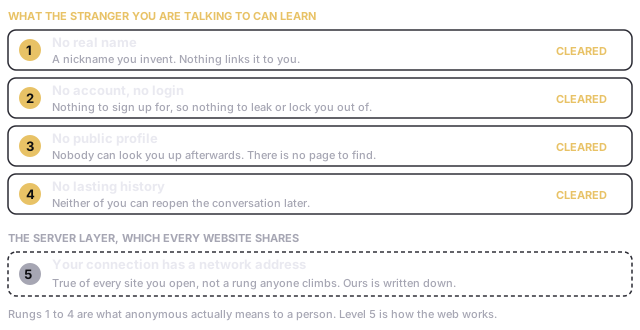
| Rung | What it protects you from | talk2strangers |
|---|---|---|
| 1. No real name | The other person cannot address you by a name you did not give | Yes, a nickname you invent |
| 2. No account | There is nothing to sign up for, so nothing to be locked out of, sold or leaked in a breach | Yes, no sign-up exists |
| 3. No public profile | Nobody can look you up after the chat, because there is no page to find | Yes, no profile is created |
| 4. No lasting history | Neither of you can reopen the conversation later, and nor can a future visitor | Yes, nothing to reopen |
All 4 rungs describe the same thing: what the stranger you are talking to can find out. talk2strangers clears every one of them.
The part of anonymous chat that is really about the server
Now the second question, the one the word anonymous is not really about. Any website you open receives the network address your connection arrives from, because that is how a page reaches your screen at all. A search engine, a news site and every anonymous chat service on this page all sit on that same floor. It is not a rung anybody climbs, and no site on the open web escapes it, whatever the front page says.
Ours is written down rather than implied. The privacy notice, last updated 27 July 2026, names what is processed: what you type, a marker saved on your device, and that network address, which narrows you to a rough region and no further. Typed content is deleted after 30 days at the latest, and anything the law obliges us to hold we hold for exactly as long as it obliges us. That is what makes acting on a report possible, which is the trade every moderated service makes.
So when a site says 100% anonymous, the useful question is not whether to believe it, it is which of the 2 questions it is answering. Toward the stranger you are chatting with, we say yes without qualification. Toward the server, no honest service claims to hold nothing, and ours is written out in full on the privacy notice, which is short on purpose.
How to message an unknown person without it being awkward
The hardest part of an anonymous chat is the first line, because there is no shared context to lean on. A greeting on its own puts the work on the other person and often gets nothing back. A question does the opposite. These 5 steps are what actually tends to work.
- Skip hi on its own. Open with a question that has more than a yes or no answer.
- Ask about the moment rather than the person: what they are avoiding doing, what is playing, what the weather is doing where they are.
- Give a small detail about yourself first, so the other person is not the only one exposed.
- Match their length. A one-word reply to a long message reads as disinterest, and the reverse reads as intense.
- Let it end. Most conversations with an unknown person are short, and that is normal rather than a failure.
None of that requires knowing who you are talking to, which is the point. The etiquette side is covered at more length in our guide to opening a conversation with someone you have never met.
Is anonymous chat safe?
Anonymity cuts in both directions, and it is worth being clear-eyed about that. It protects you from being identified, and it equally protects whoever you are speaking with, including anybody behaving badly. The practical safety of an anonymous chat therefore comes from what you withhold rather than from what the service promises. Keep your full name, address, workplace, school and money out of it. Treat a friendly nickname as proof of nothing at all. Leave the moment a conversation turns, and use the report control rather than arguing.
talk2strangers is restricted to adults aged 18 and over, carries a report control and a one-tap exit on every conversation, and has no profile system for anyone to build a false identity inside. What no service can hand you is judgement, so the ordinary habits still apply here exactly as they would anywhere else online.
What an online talking website should tell you before you type
If a site will not answer these, that silence is itself the answer. Does it require an account, and if not, does it push you towards one? Is a camera involved at any point? Does it keep message content, and for how long? Is there an age policy, and is it stated anywhere other than a checkbox? Is there a way to report someone mid-conversation? Any online talking website worth using answers all 5 without you having to dig, and the ones that bury the answers are usually burying something worth knowing.
Text or voice, and why there is no video here
talk2strangers offers 2 modes, text and voice, and no video at any stage. That is a deliberate line rather than a feature we have not built yet. Video is what makes random chat risky for most people: a face cannot be withdrawn once it has been seen, a screenshot takes a second, and one careless moment outlives the conversation by years. Voice keeps most of what text loses. Tone, timing, hesitation and humour all survive, while your face stays out of a stranger's frame entirely.
How to start an anonymous chat in 3 steps
There is no registration stage, so this takes about as long as reading it.
- Type any nickname into the panel at the top. It is not checked against anything and no profile is built from it.
- Choose text or voice, then confirm you are 18 or over.
- Open with a question, and tap next whenever you want a different conversation.
Questions about anonymous chat
- Is talk2strangers really anonymous?
- Toward the person you are chatting with, yes, completely. It clears all 4 rungs: no real name, no account, no profile and no history either of you can reopen, so a stranger learns only what you type. At the server level, like every website you open, a connection has a network address, and ours is written down in the privacy notice instead of glossed over.
- Can an anonymous chat be traced back to me?
- Not by the person you are talking to. They see a nickname and the words you chose to send, with no profile behind it to click and nothing that survives the conversation. Every website receives a network address in order to serve you a page at all, which is true of a news site as much as a chat site, and what we do with ours is set out in the privacy notice.
- Do you need an account for anonymous chat on this site?
- Not on talk2strangers. There is no sign-up, no email, no password and no social login, so there is no account to be suspended without explanation and nothing stored for a later breach to expose. The nickname exists for the length of the conversation and no longer.
Cost, age and what free covers
- Is talk2strangers free?
- It costs nothing. There is no premium level, no credit balance and no feature parked behind a wall, because typing and talking are the entire product. Nothing is ever billed, so there is nothing to cancel, and a card is never requested.
- Who is allowed to use it?
- Adults aged 18 and over only. The rule exists because a mixed-age pool is where the most serious problems in anonymous chat come from, and because moderation of an open service cannot substitute for keeping the pool adult in the first place.
- What happens if someone behaves badly?
- Use the report control and the conversation ends immediately for a moderator to look at, or tap next and you are simply gone with no explanation owed to anyone. Because no account links you to anything, walking away from a bad conversation costs you nothing at all.
Voice, phones and what remains afterwards
- Does anonymous chat work on a phone?
- Yes, straight from a phone browser. There is no install step and no app store entry to find. Voice uses the microphone once you grant permission, and declining that prompt leaves you on text with everything else working exactly as before.
- Is voice chat with a stranger still anonymous?
- Your voice is not a name, and no camera is involved, so nothing identifying is shown. Treat it as you would a call with someone you have just met: first names at most, nothing that pins down where you you spend your days, and end the call the second you would rather not be on it.
- Can I read an anonymous chat again later?
- No, and that is the trade. There is no transcript to reopen, no history to scroll and no profile the other side can revisit. A conversation you enjoyed is gone as completely as one you wanted to forget, which is the cost of the rung this service stops on.
Where to look next
If you would rather speak than type, the voice mode works the same way with no camera. For the version of this question aimed at a specific service, the four products sharing the Chitchat name shows how differently one word can be used across a single search.
Three newer pages take the same question to specific services: the five fields Chatib wants before you can type, y99's gates one at a time, and what each keeps, and anonymous against merely nameless.
Last verified: 2026-08-08
Sources read for this page: our own privacy notice for what is processed and for how long; Knot Chat, FunChat and AnonChat for the wording each attaches to the word anonymous; plus the Electronic Frontier Foundation on online anonymity for why anonymous and private are not the same thing, and internet privacy for the technical identifiers almost every website processes.