Chatingly's 3 doors, and where the no-camera one sits
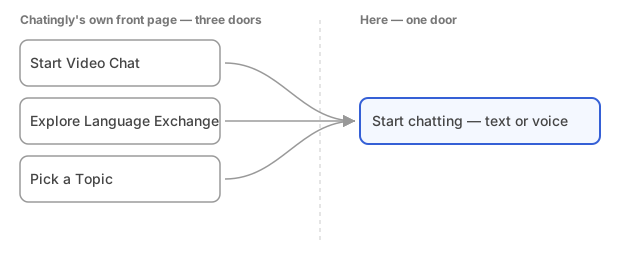
Chatingly is a free random video chat site whose homepage offers 3 doors: start a video chat, open a language exchange, or pick a topic. All 3 lead with a camera. This site is the no-camera alternative: free text or voice chat with one stranger, started from the chat tool above with only a nickname. Below, each Chatingly door is read from its own front page.
None of the 3 doors on Chatingly's own front page is optional camera use. The site's hero line says it plainly: Chatingly lets you video call random strangers. A camera is not a mode you can skip into from elsewhere on the page; it is the default the whole layout is built around, and the other 2 doors sit beside it rather than replacing it.
Enter any nickname above to begin. It runs in this tab, asks for no account, offers no webcam, and connects you to exactly one person. 18 and over.
Door one: video chat, Chatingly's default
The first door is the one Chatingly's homepage leads with. Its hero copy reads: Chatingly lets you video call random strangers, giving you the chance to make new friends, find love, and more, and the button under that line says Start Video Chat, not start chatting. A second line lower on the page repeats the same framing: instantly connect with random strangers through free video call and free video chat. Two separate mentions, both leading with the camera, is not a small design choice. It is the product.
A visitor who only wanted to type has to find the text option inside that flow rather than being offered it up front, because the front page itself does not name one. If a camera is the reason you searched for Chatingly, this is the correct door and there is nothing on this page that argues you out of it.
Door two: a language partner, not a stranger
The second door changes what a match is for. Chatingly's own copy under Explore Language Exchange reads: practice a language with a real person, live, and skip the flashcards, talk to someone right now and actually practice speaking. That is a different promise than random pairing. It is asking to be matched by what you want to practice, not by nothing at all, and the person on the other end has opted into the same trade: a conversation partner, not a random draw.
That distinction matters for what you can expect once paired. A random-pairing door owes you nothing about who shows up. A language-exchange door owes you someone who is there for the same stated reason you are, which is a narrower and more predictable promise, and a fair one to want if practising a language is actually why you came.
Door three: pick a topic before you pick a person
The third door sorts by subject rather than by person. Chatingly's own topic list, read from its homepage, includes gaming, books, music and travel, each pitched as video chat with something to talk about. Selecting a topic narrows the pool to people who picked the same one, which is a real trade: a smaller pool in exchange for a starting point neither side has to invent.
The cost of that trade is the same as any filter. A topic-first match waits on however many other people picked that exact topic at that exact moment, which the plain random door never has to do, because plain-random has no filter to wait on.
What all 3 doors claim about safety
Underneath the 3 doors, Chatingly's own front page states the same 4 safety claims regardless of which one a visitor takes: real-time AI moderation is described as on, screen recordings are called strictly prohibited, reports are said to be reviewed 24/7, and the site states outright that you must be 18 years or older to use it. Those are the site's own published claims, not something we tested, and they apply to all 3 doors identically. No single door on the front page carries a fifth or different claim of its own.
Free, anonymous, and one live counter
A separate claim on Chatingly's front page, sitting above whichever of the 3 doors gets clicked, says the platform is free to use and completely anonymous. The same page runs a live counter labelled Strangers Online next to that claim, though the figure itself loads dynamically rather than printing a fixed number, so no count from it can be quoted here as measured. What can be quoted is the claim beside it: 0 signup steps stand between the front page and any of the 3 doors, per the site's own copy.
The 3 doors against the 1 door here
The comparison worth making is door by door, since Chatingly does not run one product.
| On Chatingly's front page | Chatingly | Here |
|---|---|---|
| Default door | Start Video Chat, camera on by default | Start chatting, no camera exists |
| Language partner door | Yes, a separate matching pool by stated language goal | No; every pairing is plain random |
| Topic door | Yes, gaming/books/music/travel as pitched on the homepage | No topic filter; text or voice is the only choice made |
| Voice without video | Not offered as its own labelled door on the front page | Yes, audio is a first-class option before pairing |
| Account | Not required to start, per the front page | None, and no profile |
| Age gate | Stated 18 and older, per the front page | Over 18s only |
| Moderation claim | Real-time AI moderation, per the front page | A one-tap report button in every chat |
Chatingly column read from its own front page on 15 September 2026. Nothing here is a third-party account of the product; every claim in that column traces to the page itself.
How to pick a door in under a minute
Run these in order before opening any chat, Chatingly or otherwise.
- Decide if a camera is acceptable at all. If not, every door on Chatingly's front page still opens on video by default, so that decision alone rules it out or in.
- If you wanted a language partner specifically, use that door rather than the plain random one; it is matching you on a stated goal the random pool cannot see.
- If a topic is the point, pick it before pairing. Picking after wastes the filter Chatingly built for exactly that purpose.
- If none of the 3 applies and you only wanted a text or voice conversation with a stranger, that is the door this site runs, and it is the only one it has.
Nobody under 18 belongs here. Chatingly states the same age line on its own front page. Our behaviour policy covers what is off limits, and every chat carries a one-tap report button.
Questions about Chatingly
- What is Chatingly?
- Chatingly is a random video chat site that also runs a language-exchange matching pool and a topic-picker, all reachable from its own front page. Its own hero line describes video calling random strangers as the core action, with the other 2 doors offered alongside it rather than in place of it. Its nav menu labels the whole product an Omegle alternative.
- Does Chatingly require an account?
- No account is asked for to begin, according to its own front page, which is common across this whole category. This site asks for no account either, only a nickname.
- Can Chatingly be used without a camera?
- The front page itself names no text-only door the way it names video, language exchange and topics. The camera-first framing runs through all 3 of the doors it does advertise, which is the opposite of how this site is built: no camera exists here at any point, on any door.
The other 2 doors, and the price of Chatingly
- What is the language exchange door for?
- It matches a visitor with someone who has also opted in to practising a language, rather than pairing at random. Chatingly's own copy pitches it as practising speaking with a real person instead of working through flashcards, which is a narrower promise than a plain random pairing and a different product for a different reason to show up.
- What do the topic picks actually do?
- Selecting one, per Chatingly's own homepage, narrows the match pool to other people who picked that same topic, with 4 named examples: gaming, books, music and travel. That buys a shared starting point at the cost of waiting on a smaller pool than the plain random door draws from.
- Is Chatingly free?
- Chatingly's own front page states the platform is free to use and completely anonymous. We have not tested whether any paid tier sits behind a specific door, so read that claim as the site's own, not a measurement made here.
Skipping, safety and what carries over
- Why do other sites also rank for the name Chatingly?
- 2 of the 4 results we measured for the term are third-party pages about the brand rather than pages Chatingly runs itself, alongside a different competitor's own homepage. Worth knowing before reading any of them, this page included: a writeup about a brand and that brand's own front page are not the same source, and this page draws only from the latter.
- Is talk2strangers connected to Chatingly?
- No, this is a separate, independently-run site with no ownership tie to Chatingly or to any other brand named on this page. Naming it here is only so a visitor comparing doors knows what each one asks for before clicking through.
- What happens when someone leaves a chat here?
- The pairing ends and you both return to the front page, ready for another match. There is no profile and no account to carry into it. See what anonymous actually covers on a site built with no login of any kind.
Voice, the door Chatingly's homepage does not label
- Is speaking an option here instead of typing?
- Yes. Selecting audio up front turns the match into a spoken call rather than a typed thread, and no webcam is requested at any stage because none exists on this site. Hesitation and timing survive that trip, which typed text flattens out. The voice chat page covers what changes once both sides pick audio.
Should a chat turn toward real harm rather than company, the crisis page keeps a list of services that pick up around the clock.
Where to look next
Joingy's own next button gets the same door-by-door read at what its skip loop is actually doing, and the video-vs-text trade shows up again in what FaceFlow gives up once the camera goes.
Two further roulette brands, read the same way: how Bazoocam frames itself as international, and what a filter on Chatspin buys and costs in wait time.
Other free browser chat sites sit together on our free chat page.
Last verified: 2026-09-15
Read while putting this together: Chatingly's own front page for its 3 doors, its age statement and its moderation claims, and Joingy's own front page for the comparable video-first framing referenced above.