FTF Live says secure. Here is what its own policy says that word covers
FTF Live's own front page leads with one word: secure. It lists four claims under that banner — encrypted, private, fast, and a face check that runs locally. We read the claims against the site's own privacy policy, line by line, to see what secure actually buys a stranger and what it does not touch. This site has no camera at all, in text or voice, so start there before anything else.
A word like secure is doing a job on a homepage: it is meant to be read once and trusted. It rarely survives being read twice. Not because it is false — nothing FTF Live states on its own front page contradicts its own privacy policy outright — but because secure has a narrow, specific meaning in that policy, and a much wider one in how people use the word casually. This page holds the two apart.
No camera here, in text or voice, ever. A nickname is the only thing asked for, and you are paired with exactly one person. Restricted to adults.
What FTF Live is, and what it claims on its own homepage
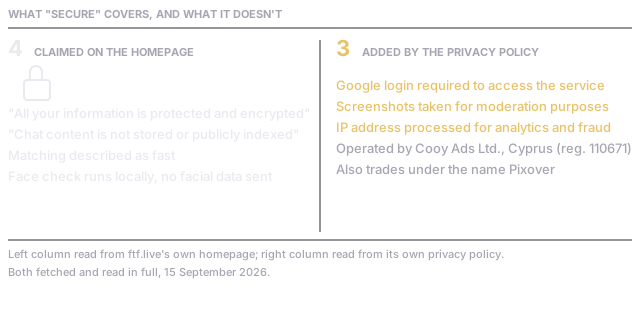
FTF.live describes itself in its own title tag as free and secure video chat with another people. We opened the live site on 2026-09-15 and read its homepage as published that day. Under a banner reading Fast and Secure Live Chat, four claims sit side by side, each with its own short line: Secure — "All your information is protected and encrypted by us." Private — "Chat content is not stored or publicly indexed. Your conversations remain private." Fast — a note about matching speed. And Face Detection — "Face presence detection runs locally in your browser to ensure a real person is on camera. No facial data is stored or sent to our servers." The page also states matching runs on filters the user sets, interests or location, to find people to "make new friends or establish business relationships."
Encryption in transit is the floor, not a feature
The first claim is the one worth being plainest about. A live video call between two browsers, on any site built this way, already encrypts the connection carrying the call — that protection is a property of how browsers handle real-time audio and video today, not something one product adds on top of another. Stating it on a homepage is accurate and also close to universal across this whole category. The same is true of camera and microphone permissions: the browser, not the website, decides whether a camera turns on, and shows its own indicator when it does. A site can ask; only the browser can grant.
None of that makes the claim wrong. It makes it a description of what any comparable product already has, stated as if it were a differentiator. What is worth reading past that floor is what a product controls instead: whether an account and an identity attach to a conversation, and what the policy behind the banner adds. Those are the questions the rest of this page works through.
What the privacy policy says that the homepage does not
We then read FTF Live's own privacy policy in full, dated 26 February 2026 on the page itself, rather than trusting the four-line summary. Two things there sit next to, rather than inside, the homepage's claims. First, registration: the policy states that "registration data is required in order for you to be able to access and use the Services," and that this data — display name, photo, username, gender, date of birth, country — "is obtained from your Google account during login," with only the email address mandatory among those fields. Opening the app page itself on the same date showed a visible Login/Register option beside a Start control and a gender filter, without walking through that flow ourselves.
Second, moderation: the same policy states that communication data "may include email address, username, avatar, IP address, and full name," and that "our system may also take screenshots of your communications with other Users for moderation purposes." The homepage's private line says chat content is not stored or publicly indexed; the policy's own wording is about indexing and public storage, and separately describes a screenshot capability for moderation, which is a different claim living one document away from the one most people read.
Two claims, read together rather than apart: the front page promises a word, secure, and the policy underneath it defines what that word actually covers — a Google-linked account by default, an IP address processed for fraud and analytics, and a moderation system able to capture what is on screen.
What FTF Live secures, and what still identifies you to it
Set side by side, the four claims and the policy that defines them read like an audit rather than a pitch. This table uses the same rows for both sites, because the question is not which product is better built — it is what each one still shows a stranger, or shows itself, once the front-page banner is set aside.
| What FTF Live secures | What it still shows a stranger | Here |
|---|---|---|
| Connection | Encrypted in transit, per its own line — the baseline for any live call | Not a point of comparison; text or voice only, never a camera |
| Camera permission | Granted or refused by the browser, not the site | No camera exists here to permit or refuse |
| Conversation content | Not publicly indexed, per its homepage; screenshots may still be taken for moderation, per its policy | Text or voice only, so there is never a video frame on screen to capture |
| Identity on file | A Google account; email required, name/photo/gender/birth date optional, per its own policy | An optional nickname. No email, no login, no account exists |
| Face check | Runs locally in the browser; not stored or sent, per its own claim | Nothing to check — there is no camera feed to run it on |
Left column drawn from ftf.live's own homepage and its Privacy Policy, both read on 2026-09-15. Right column describes this site's own design, not a claim about FTF Live.
One name, at least three domains
Searching ftf live on 2026-09-15 returned ftf.live itself at the top, and further down the same page, ftflive.me appeared twice — once under a /chat/ path and once as its own homepage carrying a "Premium Video Chat" label — alongside a third domain, ftflive.video. We have not opened either of the latter two beyond their listed search titles, so we can say only what that listing shows: at least three separate domains present a version of this same name to a searcher typing the same three words, and two of them share the ftflive spelling exactly. Anyone comparing prices, accounts or claims across "FTF Live" results should first confirm which domain a given page actually belongs to, because the name alone does not say.
The same results page also carried pages built around this term by other cam-style products positioning themselves as an "FTF Live alternative." A couple of those neighbouring sites lean adult-cam in their own branding; we are not linking to them and have nothing further to say about them here beyond noting that the neighbourhood exists, because it is a genuine feature of this specific search result and not one we are choosing to dwell on.
Three steps to a first message here
No account, no camera, and nothing to weigh against a policy document first.
- Type a nickname. No Google login, no email, no display name pulled from anywhere.
- Pick text or voice before you connect. Voice runs as a live spoken call, with no camera involved at any point.
- Press start. You are paired with one stranger and can type or speak immediately, with a fresh pairing one tap away whenever you want it.
Questions about FTF Live's security claims
- Is FTF Live actually encrypted?
- Its own homepage states that "all your information is protected and encrypted by us," and that claim matches how a live video call between two browsers works across this whole category of site. It is accurate and it is also close to standard, so it is worth reading as a floor rather than a differentiator when comparing products by this word alone.
- Does it require an account?
- Its privacy policy states that registration data "is required in order for you to be able to access and use the Services," and that this data comes from a Google account at login, with only the email address mandatory among the fields listed. We did not complete that login flow ourselves, so we report the policy's own wording rather than our own walkthrough of the form.
What it keeps, and what it checks
- Is a conversation ever stored?
- Its homepage states chat content "is not stored or publicly indexed." Its privacy policy separately states that "our system may also take screenshots of your communications with other Users for moderation purposes." Both statements can be true together — not publicly indexed is a narrower claim than never captured — and the difference is worth knowing before assuming the two mean the same thing.
- What does the local face check actually do?
- Per FTF Live's own homepage, "face presence detection runs locally in your browser to ensure a real person is on camera," and no facial data is stated to be stored or sent to its servers. We have not tested this ourselves and report the claim as published. Here, there is no camera to run any check against, because none exists on this site at all.
- Does it cost anything?
- Its own title tag describes itself as free, and we found no payment step on its front page before reaching the app screen. This site is free as well, with no paid tier and nothing to unlock. Worth confirming for yourself on any chat site before assuming free covers every feature.
Who runs FTF Live, and who it's for
- Who actually runs it?
- Its privacy policy states it is "owned and operated by Cooy Ads Ltd., a company registered in Cyprus," registration number 110671, and that the same operator also uses the brand name Pixover in support and marketing channels. That detail comes from the policy document itself rather than from anything on the homepage.
- Is talk2strangers connected to FTF Live?
- No. This site operates on its own and holds no relationship with ftf.live, ftflive.me, ftflive.video, Cooy Ads Ltd., or any other name mentioned on this page. We set the claims side by side so a reader can see what each covers before choosing either.
- Can somebody under 18 use either site?
- No. Its own privacy policy states the service "is not designed for use by anyone under the age of 18." Entry here carries the same floor, with no room or section for anybody younger. Our rules page sets out what else is not allowed.
Voice, video, and what carries over
- Can you talk out loud instead of typing here?
- Yes, and it needs no camera either. Pick audio at the start and you are placed in a spoken exchange with a single person. Pacing, hesitation and tone reach the other side intact, which is exactly what a typed message drops. The voice chat page explains how that pairing works.
- If the camera is what you actually want, is this the right site?
- No, and we would rather say so plainly than let anyone find out after typing a nickname. This site runs no camera at all, in text or voice, on any page. If a face is the point of the search, FTF Live or a comparable product is the correct tool, not this one.
- What does no registration mean on a site like this one?
- Here it means no email, no password and no account, only a nickname typed into the box above. Our page on what anonymous actually covers applies the same reading to other sites that use similar wording, because the phrase does not always mean the same thing twice.
Where to look next
The same reading applied to a translation claim instead of a security one: what CallMeChat's translation feature does and doesn't solve.
If you are weighing account requirements specifically, we ran the same reading on a Chatiw alternative that asks for no account and on one that never puts a sign-in in front of you. For the wider category of free random chat without any of these gates, see our note on what free actually covers.
If a conversation anywhere goes somewhere dark, our crisis page has services that can help.
The rest of the free browser sites we have checked are on our page on free chat.
Last verified: 2026-09-15
Read directly while researching this page: the FTF Live front page for its four security claims and its description of the product, and FTF Live's own privacy policy for its registration, moderation and data-handling terms.