strangermeetup: two sites share one name, and only one has a camera
Two different sites answer to strangermeetup, and only one of them opens a camera. The .com address is public and private chat rooms with an optional membership. A second domain, strangermeetup1.com, opens on an 18-plus question and random video calls. Check which one you have landed on before you type anything. If you want neither a room nor a camera, type a nickname above for a free one to one text or voice chat, with no account.
Two different sites answer to strangermeetup
StrangerMeetup, at strangermeetup.com, is a free chat site built around public and private chat rooms and framed around friendship rather than dating. Its own front page says registration is not needed, while also calling membership the more convenient route, and its public rooms state outright that you need an account to join. A second site, strangermeetup1.com, uses the same name but opens on an 18-plus question and describes itself as random video calls offering video, audio or text. Those are two genuinely different propositions wearing one name, and nothing on either page tells you the other exists.
Neither page is hiding anything, but a single stranger meetup search surfaces both, and they set different expectations about cameras, accounts and rooms. Knowing which strangermeetup you opened matters more than any feature comparison, because that answer decides whether a webcam is part of what you are agreeing to. It is the first thing we would check, before reading a single feature list, and it takes about five seconds: look at the address bar and see whether there is a 1 in it.
Five checks before trusting any stranger chat site
Rather than argue brand against brand, here is the rubric we apply to every service in this category, including our own. It is deliberately reusable: run these five questions against strangermeetup, against talk2strangers, or against any other stranger meetup you are weighing, and the answers tell you more than a feature list does.
The five checks, applied to both
| The check | Why it matters | StrangerMeetup | talk2strangers |
|---|---|---|---|
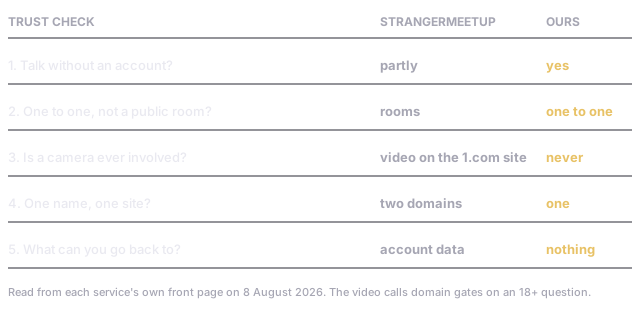
| Can you talk without an account? | An account is the thing that can be banned, leaked or sold | Partly. The .com says registration is not needed, then recommends membership, and its public rooms require one | No account exists, and none can be created |
| One to one, or a public room? | A room lets one spammer reach everyone at once | Public and private chat rooms | Always one to one |
| Is a camera ever involved? | A face cannot be taken back once it is on someone's screen | Yes on strangermeetup1.com, which opens on random video calls | No video at any stage |
| One name, one site? | Multiple domains make it hard to know who you are dealing with | Two domains under one name | One domain |
| What can you go back to afterwards? | Anything you can reopen is something someone else may reach | Account and membership data for members | Nothing to reopen: no history, no transcript, no profile |
The StrangerMeetup column is read from each domain's own front page on 8 August 2026.
The same five checks as a scorecard
What strangermeetup reviewers actually report
The chat-rooms domain's Trustpilot listing sits at 2.6 out of 5, and honesty requires saying immediately that this rests on only 6 reviews with none posted in the past twelve months. 4 of the 6 are 1-star and 2 are 5-star, with nothing in between. That is far too small a sample to call a verdict on strangermeetup, and we are not presenting it as one. What makes it worth reading is that the same themes recur, and they are the themes an account-based service tends to generate: something to ban, something to fake, something to leak. Here is what people wrote between 2018 and 2023.
- Bans arriving without a stated cause, and, from a reviewer who otherwise rated it five stars, a three-strike pattern ending in a temporary lock.
- Spam bots and fake profiles, raised by two reviewers, one calling it the site's general condition.
- Reluctance to sign up at all, on the grounds that handing data to a chat site is a risk.
- A complaint from someone who says they have never used the site, reporting that their phone number was being passed around on it by a minor. That is the most serious of the four, and also the one whose context matters most.
Rooms versus a private one to one match
The rooms model is the real structural difference between strangermeetup and this one, and it is the part worth understanding before you pick either. A public room is efficient for a spammer, because one message reaches everyone present and the sender can leave before anyone reacts. It also means your words sit in front of an audience you did not choose, which is the part of the strangermeetup model that the review complaints keep circling back to. Rooms also make moderation harder, because the volume of messages grows with the number of people rather than with the number of conversations.
A private match removes both problems: there is no crowd to broadcast at, and no gallery watching you try to start a conversation. Nobody can build an audience, so nobody has a reason to perform for one. You still meet people at random, and you still move on whenever you like, but the failure mode is a dull chat rather than a room full of the same forwarded link. If the appeal of a stranger meetup was the room itself rather than the conversation, strangermeetup is the better fit and this is not.
Where StrangerLine fits in the same search
StrangerLine turns up near these queries often enough to mention. It offers text, voice and video with no sign-up, and advertises more than 5,000,000 conversations, more than 190 countries, a match time under 3 seconds and round-the-clock moderation. Those are its own published figures and we have not tested them, which is worth saying plainly because vendor statistics in this category are almost never independently audited and we are not going to present someone else's marketing as a measurement.
The relevant difference for anyone weighing a strangermeetup alternative is the camera: StrangerLine includes video, and talk2strangers does not. On that single question StrangerLine sits on the same side as strangermeetup1.com, and we sit on the other. If video is not a dealbreaker for you, StrangerLine is a reasonable option and we would rather say so than pretend the field is narrower than it is.
What talk2strangers does differently
talk2strangers is a free browser based chat site that connects you with a random stranger for a text or voice conversation, one to one rather than in a room. It asks for a nickname and nothing else: no sign-up, no email, no password and no profile page, so there is no account anybody can suspend without explanation. Voice keeps the tone, timing and humour that typing flattens while leaving your face out of it. When you close the tab there is nothing for you to return to, which is the point rather than a limitation.
What talk2strangers does not offer
The honest half of the comparison. There is no video here and there will not be, so if a camera is what you came for then strangermeetup1.com covers it and we do not. There are no public rooms, which means no lurking and no group banter if that is what you enjoy. There is no friends list, no history and no way to find someone again after a chat ends, so a conversation that was going well is simply over when one side closes the tab. There are no interest filters either, which means the match is genuinely random rather than steered towards something you have in common.
On the record side we are precise rather than absolute, because an absolute claim would not be true. There is no account and no profile. Message content is held briefly and then deleted, and only what the law requires is kept beyond that. Our privacy notice sets out the detail, and it is worth reading before you trust any stranger meetup with a conversation.
What to use instead of StrangerMeetup
If the strangermeetup name brought you here and you want a conversation rather than a membership, these are the real options, described by what each one asks of you. Two of them are strangermeetup itself, so the choice is not simply strangermeetup or not, it is which strangermeetup and at what cost.
- strangermeetup.com. The original strangermeetup: public and private chat rooms, friendship framed, membership recommended and required for the public rooms. Pick it if you want a room and a community you return to.
- strangermeetup1.com. The second strangermeetup domain. Random video calls behind an 18-plus question, offering video, audio or text. Pick it if a camera is what you came for.
- StrangerLine. Text, voice and video with no sign-up, by its own description. Pick it if you want the option of video without an account.
- talk2strangers. One to one text or voice with a random stranger. Free, no account, no download, no video, adults 18 and over. Pick it if you want neither a room nor a camera.
How to start in three steps
No registration stage means there is very little between you and a conversation.
- Pick any nickname in the panel near the headline, then confirm you are 18 or over.
- Choose text or voice before you start, and switch on a later visit if you prefer.
- Say something ordinary to whoever you are matched with, then tap next to move on or report anyone breaking the rules.
Questions about strangermeetup
- Is strangermeetup safe?
- Its reviewers raise spam accounts, fake profiles and unexplained bans, though across only 6 Trustpilot reviews, which is too thin to generalise from. The structural point about strangermeetup is steadier than the score: a service holding an account holds more about you than one holding nothing.
- Why are there two strangermeetup sites?
- We cannot tell you who operates strangermeetup.com or strangermeetup1.com, and we will not guess. What is checkable is that the two present differently: one leads with chat rooms and a community framing, the other with random video calls behind an 18-plus question.
- Does strangermeetup need an account?
- The strangermeetup page says registration is not needed, then recommends becoming a member as the more convenient route, and its public chat rooms state that you need an account to join. That pattern is worth noticing, because the convenient path is usually the one that creates a lasting record.
- Is talk2strangers connected to strangermeetup?
- No. talk2strangers is an independent service with no relationship to either domain carrying the strangermeetup name. We describe them here only because people comparing options deserve an accurate picture of what they will be asked for at the door.
Cost, age and what free covers
- Is talk2strangers free?
- Yes, with no paid tier, no credits and no membership upgrade, which is the main practical difference from the strangermeetup membership route. Text and voice are the whole product, and neither is held back. There is nothing to cancel later because there is nothing to sign up for in the first place.
- Who is allowed to use talk2strangers?
- Adults aged 18 and over only. That rule exists because an open stranger meetup with a mixed-age pool is where the most serious complaints in this category come from, including one of the strangermeetup Trustpilot reports summarised above.
- What if someone behaves badly?
- Tap report and the chat ends immediately for a moderator to review, or tap next and you are gone with no explanation owed. Because no account links you to anything, moving on genuinely costs you nothing.
Voice, phones and privacy
- Does talk2strangers work on a phone?
- Yes, in any modern phone browser, with nothing to install. Voice uses the microphone once you grant permission, and declining that prompt leaves you on text with everything else still working.
- Is voice chat with a stranger private?
- It runs between the two sides of the conversation and is not replayed to anyone else. Treat it as you would a call with someone you just met: first names only, nothing that pins down where you live or work, and hang up the moment it stops feeling right.
- Can you find the same person again later?
- No, and that is deliberate. There is no profile, no history and no friends list, so a conversation you enjoyed cannot be resumed. It is the honest cost of a service built to leave you nothing to return to, and the same decision that means nobody can look you up afterwards either.
Where to look next
The rubric above asks what survives a session, which is really a question about anonymity. We took that apart on its own: anonymous to whom, and why it matters sets out the four rungs that decide what a stranger learns, and keeps them separate from the server layer every site sits on.
Still comparing? Our read on TalkWithStranger covers the closest room-based service, the no-signup case against Knot Chat deals with services that ask for an account up front, and speaking instead of typing explains the voice mode in more detail.
Last verified: 2026-08-08
Checked against: the chat rooms domain, the video calls domain, the public review listing for the rating, review count and dates, and StrangerLine for its own published figures.