Voice chat room: pick the size, fix the echo, stay safe
Nine friends start a call on a Friday night. Three talk at once, a fan roars behind a fourth, and a fifth hears her own voice return half a second late. That is a voice chat room that is too big and badly set up. A good one holds 3 to 5 voices, puts headphones on every head and gives one person the job of steering, so that each speaker is heard once and nobody waits long. Everything below follows from that.
Prefer a voice with no room around it? Type a nickname above for 1 adult stranger, live audio, and Next whenever you want someone else.
Voice room, text room, direct call or big public app?
Four formats cover nearly every search for chat rooms with voice, and each fails somewhere.
| Question | Small voice room | Text room | 1:1 voice call | Big public voice app |
|---|---|---|---|---|
| Usual size | 3 to 5 people | Any number, still readable | 2 people | Large, mostly silent |
| Pace | Fast, overlap-prone | Slow, scrollable | Natural turns | Chaotic, or run by a queue |
| Fails when | One bad mic spoils it for all | Warmth or speed matters | The other person goes quiet | Nobody hosts |
| Privacy | As private as the invite link | Your voice stays unheard | Only 1 person hears you | Unknown listeners are possible |
| Best for | Planned talk with people you trust | Noisy places, late hours | Getting to know 1 person | Listening to an event |
We did not measure these cells. They are reasoning from how each format works, not data.
How a room works, and why about 4 is the ceiling
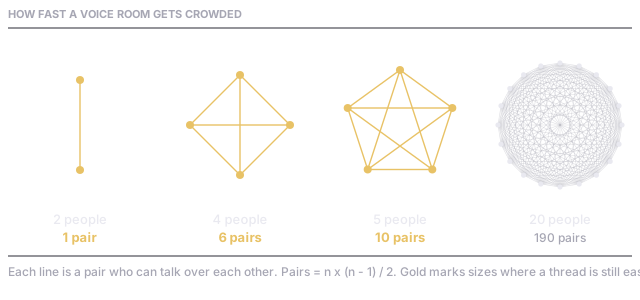
In any voice room, everyone hears everyone, and the trouble shows once you count the connections. A room of 2 has 1 pair of speakers, a room of 5 has 10, and a room of 20 has 190. Every pair is a chance to talk over someone. Dunbar, Duncan and Nettle reported in 1995 an upper limit of about 4 people in freely forming conversations, after which groups split into side talks. A chat room voice setup cannot split itself, so it just gets louder. Text rooms dodge this because reading is private and scrollable, while voice is live, once, in order.
Echo, hiss and a silent mic in a voice chat room: common fixes
Chat room voice is only as good as the weakest setup in the room.
- Echo. One person's speakers feed their own microphone, and headphones on that person end it. To find them, ask everyone to mute in turn until the echo stops. Phone-line guidance treats one-way delay under 150 ms as fine and wants echo control past 25 ms, so a late echo is a setup fault.
- Silent mic. Browsers ask permission once. If you tapped Block, open the padlock beside the address, set Microphone to Allow and reload. On a phone, check the system setting too.
- Hiss or hum. Move away from fans and charger cables. Wired earphones with a mic usually beat a laptop mic.
- Robot voice, dropouts. The signal is weak, so sit nearer the router, pause big downloads, or swap mobile data for wifi, or the reverse.
How to set up and run a good voice chat room in 5 steps
- Decide the size and purpose before sending any link, since a book club and a late-night wind-down need different rules.
- Ask everyone to wear headphones and say one test sentence before the topic starts.
- State 3 house rules aloud: one speaker at a time, mute when idle, and leave freely with no explanation.
- Steer as host. Greet each newcomer by name (the openers guide has lines that work), and ask quiet people a direct question.
- Close on purpose with a closing line and a next time.
Safety habits when strangers share your voice chat room
A voice gives away more than you plan to say: accent, background noise, a sibling shouting your name. Share no surname, workplace, address or number.
Public rooms are open doors, so safety rests on a host you may never meet. A private room is a locked door: the name and password do the work, and the host decides who gets the link. Small and private is easier to judge, not automatically safe. If someone turns abusive, leave first and debate never. Mute them, report them inside the app, then move on. Threats, sexual pressure and fraud are more than rudeness. In India you can call the helpline 1930 or file at cybercrime.gov.in. If you feel unsafe or low, our crisis page lists services that pick up.
Talking when typing is the hard part
Voice helps people who type slowly, struggle with spelling, have sore wrists or simply think aloud. It does not suit everyone: people who are deaf, hard of hearing or nervous about an accent will do better in a text room, so offer both when you host.
What we offer: private voice rooms and 1:1 voice
Create a private room with a name of letters and numbers, at least 3 characters, and a password of at least 8. Confirm you are 18 or over, then share the invite link. A room holds up to 5 people and runs as voice or text. Many chat rooms with voice are public, so this is the locked version. The other door is random voice: 1 stranger, a nickname only, no account, no download and no video, with Next to skip to another person. Nothing here matches you by location or distance or asks for location access. The voice chat page covers pairs, and the chat room page compares rooms.
This site is for people aged 18 or above. Creating a room asks you to confirm it, and the acceptable use rules say what is never allowed.
Voice chat room questions, answered short
Size and gear
- How many people should be in a voice chat room?
- Aim for 3 to 5. Past about 4, spontaneous talk tends to fragment, and in live audio the fragments overlap instead of separating. Larger groups need a host and a speaking order.
- Do I need headphones?
- Strongly recommended. Without them, your speakers leak into your mic and everyone hears themselves a moment later. Cheap wired earphones with a built-in mic solve most echo for almost nothing.
- Who is causing the echo?
- Rarely the person who hears it. The echo comes from whoever plays the room through speakers. Have people mute one at a time and listen for the moment it stops.
- Can I join without a microphone?
- Yes. Most rooms let you listen, and text rooms need no mic at all. Add a microphone later if you want to speak, and ask the host first in a small room.
Safety and trouble
- Is a public voice room safe for a first try?
- Safe enough if you stay anonymous, keep personal details private and are ready to leave at once. A public room cannot promise who walks in, so treat it like a busy street.
- What should I do if someone is abusive on a call?
- Leave without replying, mute them if you can, and report them to the people running the app. For threats or fraud in India, call 1930. Do not argue; it only rewards them.
- Can I find chat rooms with voice near me?
- Not here. This site does not match by location or distance, and it never asks for location access. You get a private room you create yourself, or a random voice pairing.
Running a room
- Is a voice room better than a text room?
- Neither is better. Voice carries tone and moves faster, but it needs quiet and a free moment, while text is slower and easy to reread. Pick based on where you are tonight.
- How do I stop a room turning into a shouting match?
- Set the rules before anyone speaks: one voice at a time, mute when idle. The host then calls turns by name and keeps the group small enough for everyone to follow.
- Does voice use a lot of mobile data?
- Audio is far lighter than video, but long calls still add up on a small plan. Use wifi where you can, leave when you finish, and keep an eye on your plan if a room runs for hours.
Outside reading behind the numbers: the 1995 conversation-size study abstract for the limit of about 4, a networking explainer on voice delay for 150 ms and 25 ms, and the national cybercrime reporting portal for filing in India.