chatkaro: picking Hindi, Hinglish or English before you say hello
chatkaro is an Indian chat brand rather than one site. The name is also an instruction in Hindi: chat karo, roughly go on and chat. Search the word from India and you get free room-based sites at chatkaro.in, chatonline.chatkaro.com and chatkaro.org, sorted by city and by language, none of them asking you to register before you speak.
That double meaning drives the chatkaro search. Somebody typing it may want the brand by name, or may just be telling a search box what they want to do, in their own language. We read the top seven results on 6 September 2026 from an Indian connection: six are the brand's own pages or listings of its app, and only a guest-room page on y99.in is an outsider. That is close to a brand wall and we will not dress it up as an opening. Anybody searching chat karo from a phone is asking for both things at once.
We wrote this anyway, because the language question sitting under the query is a real one and nothing in that ranking answers it.
Nickname in the box and you are talking. No form, nothing to install, no camera at any stage, one other person on the line. Over-18s.
What actually sits behind the chatkaro results
The first result is a room directory. Its own copy runs city names and language names together in one list: Delhi, Mumbai, Chennai, Kolkata and Pune sitting beside Hindi, Tamil, Telugu, Malayalam, Punjab and Desi. The third result puts the same idea on a sister domain and is blunter about its terms. You must be 18 or over, it says, and sharing a phone number or an email address inside the chat is prohibited. Its copy dates the service to 2009. Neither page publishes a single question and answer. Both are chatkaro doors rather than reading, and on each of them the room name is the whole product.
Two of the seven are listings for the same chatkaro chatting app rather than places to talk, and a further domain in the family adds nothing new. Strip those out and the ranking is one brand repeating itself, plus a guest-room page built on the phrase online chat karo.
That page publishes its own figures: roughly 13 thousand active chat groups, and about 900 anonymous rooms created every three days. They are its numbers, on its own site, and nothing outside it supports them.
The chatkaro Hindi room at number four
The fourth result is the one that matters here, because it is not a general room. It is a dedicated Hindi room, titled as free online Hindi chat with no registration, and its heading pairs the English name with हिन्दी चैट. Its copy says it supports Devanagari, so you can type proper Hindi from a phone keyboard, and that the room is moderated around the clock against spam and harassment. It opens in Hinglish rather than English: Hindi mein baat karo. It also points to a wider India room for mixed-language talk, and separate Tamil and Pakistan rooms.
Two claims on that chatkaro page need a label. It says Hindi is spoken by over 600 million people worldwide and that its community is the largest of its kind online. Both are its own assertions, uncheckable from outside, so we repeat them as claims. What is checkable is the shape: four published questions, one language per room, a nickname at the door.
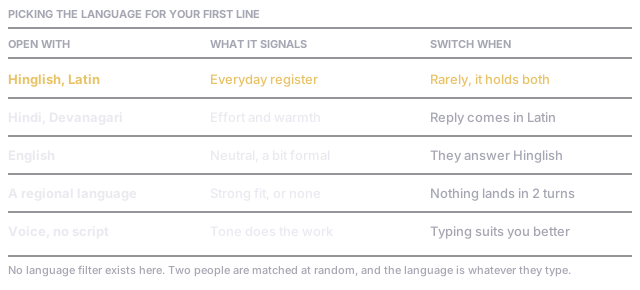
Hindi, Hinglish or English: the chatkaro picking card
The query chat karo is, underneath, a question about language, and no chatkaro page in that ranking treats it as one. Two people who both read Hindi and English still have to land on a single register inside the first ten seconds, and that choice sets the tone for everything after it.
| Open with | What it signals | Consider switching when |
|---|---|---|
| Hinglish, Latin script | Everyday register, quickest to type | Rarely. It absorbs either answer |
| Hindi, Devanagari | Effort and warmth, slower on a phone | The reply arrives in Latin script |
| English | Neutral, a little formal | Two replies come back in Hinglish |
| A regional language | A strong fit, or none at all | Nothing lands after a couple of turns |
| Voice, no script | Tone carries what spelling cannot | Typing suits you better that evening |
Our editorial read, formed while working through the cached chatkaro ranking on 6 September 2026. A judgement, not a measurement of anybody's behaviour, and no language filter exists here that could turn it into one.
What changes when you switch language mid-chat
Switching is not free, and it helps to know what you are spending. Moving from English into Hinglish usually loosens things: sentences shorten, jokes arrive, and the other person tends to mirror it inside a turn or two. Moving the other way, from Hinglish into careful English, reads as a small step backwards, and plenty of people take it as the conversation turning formal or winding up. Going into Devanagari mid-chat is the largest jump of the three, because it changes the physical effort on both keyboards at once. Hinglish in Latin script is the one opening that costs neither keyboard anything.
None of that is a rule. It is simply what a script change asks of whoever is reading it. A chatkaro language room removes the decision by settling it before you arrive; a random pair hands it straight back to you, which is why your second message matters more than your first. Look at what came back and match it rather than defending your own choice. If they answered in one word, the language was probably not the problem.
The chatkaro gap we are not going to hide
This site runs no Hindi room, no Tamil room, no city room, and no language filter of any kind. Two people are put together at random and whatever they type is what the conversation is in. Against a page built entirely around one language, that is a real disadvantage.
We say it plainly because the alternative is a page quietly implying a straight swap. Somebody who typed chat karo into a search box wanted a language, not a brand, and a room settles that language before anybody speaks. A random pair settles nothing about it, and you may spend a few skips finding somebody whose Hinglish sits where yours does. What the pair gives back is the missing audience: no regulars, no scrollback, nobody performing to a gallery.
Five moves before you say hello
In the order that actually settles it, whether you end up here or on a chatkaro room.
- Are you over 18? If not, stop here. This site has nothing for you and will not build it.
- Need the language guaranteed before you type? A dedicated room is the right tool, and we are not it.
- Open in Hinglish unless you have a reason not to. It is the register that survives either answer.
- Read the reply rather than your plan, and match their script on message two.
- Want tone instead of spelling? Take the audio option and let the accent do the work.
Voice, and the moment script stops mattering
Typing forces a decision about script that speaking never asks for. Say the same sentence out loud and the Hinglish question disappears, because nobody transliterates speech. What replaces it is accent, pace and the small pauses that tell you whether the other person is comfortable, and those travel across a language gap far better than a typed line does. It also removes the slowest part of Hindi on a handset, which is the keyboard. The audio option is settled up front rather than mid-chat, it carries two voices and nothing else, and no camera exists here at any point.
Nothing we read across the chatkaro ranking described talking out loud, though we only have what those pages publish. The cost on our side is that speech is harder to leave politely and gives away more than a nickname does. Age, mood and region all travel in a voice whether you meant them to. Our page on talking out loud sets out the rest.
Questions about chatkaro
- Is chatkaro one website?
- No. The ranking shows at least three separate domains carrying the name, plus two listings for a chatting app that shares it. Which chatkaro you meant depends on whether you wanted a city room, a Hindi room, or the app.
- Does chatkaro ask you to register?
- Every page in that ranking we could read says no. A nickname is the whole door on the brand's Hindi room, and its sister domain says you can enter chat without registering. What differs here is the next step: a room there, one paired stranger on this site.
- What does chat karo actually mean?
- It is Hindi, and it reads as an instruction: go on and chat. Some people typing chat karo want the brand by name, and some are simply telling a search box what they want to do, in the language they would do it in.
- Are you connected to ChatKaro?
- No connection of any kind, and none with the guest-room site in the same ranking. We describe both from their own published pages, so that somebody weighing the options knows what each one asks for before typing a word into it.
Language, script and switching
- Does Hindi work here?
- Yes, in the sense that nothing stops you. Type Devanagari or Latin script and it relays exactly as sent. What we cannot do is find you a Hindi speaker, because there is no language filter and no Hindi room here, unlike the chatkaro one.
- Is Hinglish a safer opening than Hindi?
- In our judgement usually yes, because it is readable to somebody leaning either way and it is the fastest thing to type on a standard phone keyboard. That is an editorial call rather than a measurement of anything.
- Do regional languages work?
- They work when both people share one and stall completely when they do not. The chatkaro brand answers that with separate rooms, Tamil among them, which is a real solution we do not offer. Here, test it in one line and move on quickly.
- Does switching script mid-chat lose people?
- Sometimes, and more often when the switch runs toward formality than away from it. English into Hinglish tends to relax a conversation; Hinglish into careful English can read as a polite exit. Mirroring the reply solves most of this.
Age, cost and what is kept
- Does any of this cost money?
- Nothing does, and no upgrade waits behind it: no coins, no credits, no priority queue. Worth checking on any chat name you compare, since the word free frequently covers only the front door rather than the part you actually wanted.
- Can under-18s use this site?
- No. Over-18s only, with no exception and no room built for anybody younger. The guest-room result in the chatkaro ranking states in its own copy that a teen or an adult may use its service. We do not.
- What happens to the messages afterwards?
- They stop existing rather than being filed. No transcript comes back to you, no profile collects them, and no search here will surface somebody you spoke to yesterday. Our privacy notice puts real retention periods against that.
- Who reads a report?
- A person does. No moderator sits inside a one-to-one chat, because there is no room for one to sit in, so the controls are yours: one tap to leave, one tap to report. Our house rules set out the lines.
Where to look next
Still comparing after the chatkaro ranking? how far anonymity actually goes on a chat site is the question to carry into any of these, and our read on free chat sites goes through the costs the word free tends to hide.
If a desi-flavoured random chat was the real target, our tohla page covers that corner directly.
If this was useful, so is choosing between a stranger, a friend and a professional, alongside which of the three live chats you actually meant.
Two more on what a site wants before the first word: chatting now with no login step at all, and text and voice with no video attached.
Last verified: 2026-09-07
Read directly for this page: the chatkaro brand's Hindi room for its Devanagari support, its moderation claim and its four published questions, and the guest-room page built on the phrase online chat karo for its room-count figures and its stated position on teenage users.