I want to talk to someone: picking the right place
If you want to talk to someone right now, there are four realistic places to take it: a stranger, a person who already knows you, a trained professional, or a group built around one shared thing. This page is a short checklist for picking between them. A stranger is honestly the right answer for some of that list and the wrong one for the rest, so we say which.
Worth clearing up first, because the results are confusing. I Want to Talk is also a 2024 Hindi film by Shoojit Sircar, starring Abhishek Bachchan, and most of what a search returns is about that film. Links to it sit at the foot of this page. Everything else here is about the other meaning.
The box above takes a nickname and nothing else. No email, no password, nothing to install, no camera at any point, and one person on the other end.
What “I want to talk” usually means
The sentence sounds simple and it is not. I want to talk can mean you want company while the washing up gets done, or that something happened today and you have nobody to tell, or that it is two in the morning and the house is very quiet, or that a thing has been sitting on you for weeks. Those four wants look identical from outside and they need four different rooms. Most of the bad advice on this subject treats them as one problem with one answer, which is why so little of it helps.
It is also worth saying that wanting to talk is not a symptom of anything. People have always wanted more conversation than their day supplies. Boredom counts, curiosity counts, and so does wanting to hear a voice that is not a recording. You do not need a reason that would survive being read out loud.
Four places to take it, and what each is for
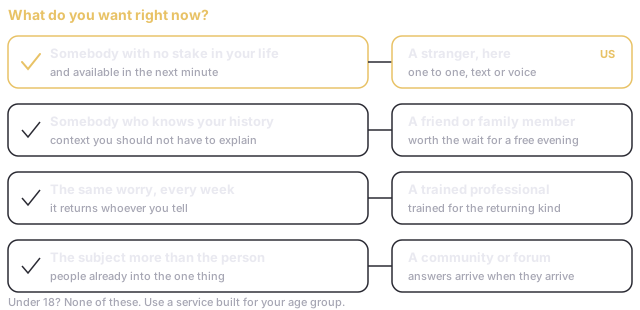
The same four options the checklist uses, laid out by what each is structurally able to do. Three of them are not us.
| Where to talk | What it does well | What it cannot do |
|---|---|---|
| A stranger here | Company right now, with no stake in your life | Anything that needs your history |
| Someone who knows you | Context, and lasting past tonight | Being free the moment you are |
| A trained professional | The worry that keeps returning | Casual company |
| A community or forum | The shared subject | One-to-one attention |
Each row describes what the format can do, not how good one particular conversation will be.
The checklist: six questions that settle it
Work down it and stop at the first yes. Order matters here.
- Are you 18 or over? If not, stop, and use a service built for your age group.
- Finish the sentence. I want to talk about what, and does the listener need your backstory?
- Is it the same worry every week? That is what a professional is trained for.
- Do you want to be known, or to be new? Old friends give the first, a stranger the second.
- Do you want the subject more than the person? A community that is already about it wins.
- Still here? Then a stranger fits, and the box at the top is the whole setup.
When a stranger is the right answer
A stranger is unbeatable at one particular thing: talking to you with no stake in your life. Nobody is keeping score, nobody brings it up at a family lunch in December, and nothing said adjusts how anyone sees you tomorrow. That is why people tell a stranger on a train what they have never told a housemate of six years. It runs both ways, too. You get to hear how somebody several time zones away spent their Tuesday, which is a small thing and a genuinely good one. That trade is the whole appeal.
The second thing a stranger is good at
The second thing it is good at is immediacy. A friend is asleep, at work, or three replies behind. A professional has a waiting list. A forum answers in the morning, if it answers. A random pair is the only one of the four that reliably produces a person in under a minute, whatever hour you are reading this. If you would rather hear it than read it, talking out loud is offered as well, audio in both directions and no video anywhere in it. Our notes on speaking instead of typing go further.
When a stranger is the wrong answer
Three cases where I want to talk points somewhere other than here, and we would rather lose the visit than get these wrong. If what you need to say only makes sense to somebody who knows your history, a stranger starts at zero and the whole conversation goes on setup. If the same worry returns no matter who hears it, more conversations will not shift it, and that is not a failure of the conversations. And if what you want is a friendship that outlasts tonight, this is the wrong shape, because a chat here ends when it ends.
If tonight is heavier than a chat with a stranger should be asked to carry, our page of helplines and text lines lists services staffed by people trained for it. It is there whether or not you think you qualify.
The age line belongs here too. Everyone on this site is 18 or over, and a younger reader has landed on the wrong page. Services built for under-18s exist and are staffed differently, and that is where to go. Our house rules put it less gently.
Questions people ask before starting
- Is “I want to talk” an odd thing to type into a search box?
- Not at all. It is one of the more honest things a person types, and the sheer number of pages written to answer it says how ordinary the request is. Wanting conversation sits about where wanting food sits.
- Will somebody actually be there?
- Usually within seconds, though it varies with the hour where you are. Quiet stretches happen, and nobody can honestly promise a person at four in the morning. Pressing next again costs a second and nothing else.
- What do you say to a stranger first?
- Ask something small and answerable rather than opening with the reason you came. Where are you, what time is it there, what are you avoiding. Our guide to opening a conversation collects more of these, including the ones that fail.
- Can this replace a friend?
- No, and it is not built to. There are no profiles, no way to add anyone, and no route back to a person once the tab closes. What it replaces is an hour with nobody free, which is a smaller job done well.
- Does any of this cost money?
- No. There is no account to create, so there is nothing to bill, and no upgrade waiting behind the useful part. Worth checking on any site you compare, since free often means free until the bit you wanted.
Privacy, endings and what to read next
- What happens to the messages?
- They are not stored for you to reopen, and neither side is handed a transcript at the end. Exact retention periods, rather than reassuring adjectives, live in our privacy notice, which is short enough to read in full.
- Does anyone see your face?
- No camera is used at any stage and there is no way to switch one on, because the feature was never built. Text is typed. The spoken option carries audio in both directions and nothing else.
- What if the person is unpleasant?
- One tap ends it and puts you with somebody else. A second tap reports them to a human who reads it. You owe a rude stranger no politeness and no explanation for leaving, and leaving is the expected move.
- What else is worth reading here?
- Two, depending on where the checklist left you. What anonymous actually covers pins down a word most chat sites use loosely, and the case against installing anything is worth a minute if you were about to download something.
Nearby on the site sit which of the three live chats you actually meant and telling a person from a software persona.
Two older pages sit close to this decision: what one ambiguous search actually returns, and text and voice with no video and no sign-up.
Last verified: 2026-09-07
The three pages we leaned on for the film facts above: the encyclopaedia entry for that 2024 release, a film catalogue page for its cast and 123 minute runtime, and a first-person essay published under the same four words, the only result on that search that is not a film listing.