Chato chat: what a video call costs you against text or voice
Chato is a name worn by more than one product. Four of the five listings we read for the word point at an Android app called Chato that does live video calling. A fifth points at a second, unrelated app carrying the same short name. If the video app is what you came for, go install it. This page is about the format itself.
Here is the observation that started it. Every chato branded product assumes the answer is video, and none of them ask what video costs first. A camera decides who is willing to speak, what the room behind you must look like, and whether the call survives a weak line. Text and voice each drop part of that load. We run a text and voice site with no camera, so we have a stake here, and you should weigh what follows accordingly. The comparison below is built to be checked rather than to flatter us, which is why every row states whether it is a measurement.
Type a nickname to reach one stranger. It runs in the tab you already have open, with nothing to install and no camera at any point. Adults only.
Which product the word chato points at
A chato search is not about one thing, and that matters before any comparison. Two separate listings on the same app store carry the name, under different package identifiers and different publishers. One is titled Chato with the words video chat attached. The other is titled plainly Chato and nothing more. Mirrors and software directories list the first of those again under near identical names. So a chato chat query can mean at least two apps, plus older senses of a common Spanish word that have nothing to do with messaging at all.
We are none of those. This site is a browser page pairing two adults for one conversation, in typed text or live audio, then forgetting it. No download, no profile, no camera. Saying so early beats burying it four sections down.
What a chato style video call asks of you
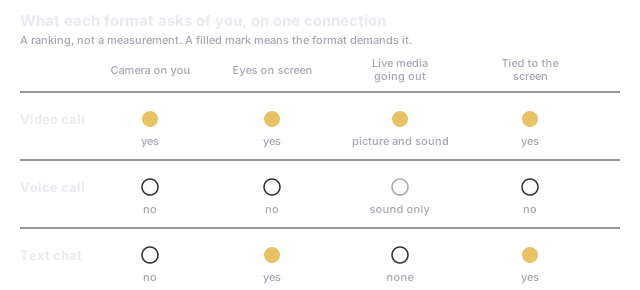
Strip the marketing off a chato style call and it makes four demands at once. It wants a camera on your real face. It wants your eyes on the screen throughout, because looking away reads as rudeness. It wants a continuous outbound stream of picture and sound, not sound alone. And it pins you to wherever the phone is propped. No single one is huge. Together they decide who joins, how long they stay, and how honest they are willing to be. That cost is paid before the first word.
Chato chat against text and voice, on one connection
The third column is the important one. It says whether each row is a measurement or a judgement. We ran no bandwidth test, so nothing here claims megabytes per minute.
| What it demands | Video, voice, text | Measured? |
|---|---|---|
| Camera on your face | Video yes; voice no; text no | Definitional, not measured |
| Eyes fixed on a screen | Video yes; voice no; text yes | Definitional, not measured |
| Live media leaving your device | Video sends picture and sound; voice sends sound; text sends characters | Ordering only. Not measured |
| Can you walk away | Video no; voice yes; text no | Definitional, not measured |
| Bytes before a word is said | The chato app install is listed at 94 MB; a browser page installs nothing | Sourced from the listing |
| Minimum device | That listing requires Android 7.1 or newer; a browser page needs a browser | Sourced from the listing |
| Battery drawn | Video heaviest, voice next, text lightest | Ordering only. Not measured |
Rows marked not measured are judgements about what a format inherently requires, stated as an ordering and never as a figure. Quote only the two sourced chato rows as numbers.
The one chato number we can source, and its arithmetic
A download mirror lists the current build of the chato video app at 94 MB, beside a header figure of 223 MB on the same page. The listing disagrees with itself, so we take the smaller and flag it. The working: 94 MB is 94 times 1,048,576, or 98,566,144 bytes. A sixty character message in plain text runs about sixty bytes. Divide, and one install is worth roughly 1.6 million such messages. That ignores every layer of protocol overhead, so read it as a floor, not a forecast.
The arithmetic shows a shape, not a speed. Typed chat stays cheap on a bad line, an old handset and a shared data pack. Video does not, and no compression changes which one you can hold on a train.
Where voice sits between the two
Voice is the format people skip, and the interesting one. It carries tone, hesitation and laughter, all of which typing flattens. It asks for no camera, no lighting and no tidy wall behind you. You can pace, wash up, or shut your eyes while talking. What it costs is the ability to hide, since a voice gives away mood and rough age within a sentence. That trade suits some people exactly and repels others, so we make you pick at the door instead of halfway through a conversation. Our voice chat page covers how the pairing works.
What this chato alternative does not do
No video, ever. If the appeal of the chato app was seeing a face, filtering by country, using beauty filters or building a friends list, nothing here replaces any of it. We keep no profiles, so nobody can be found again once a chat ends. There is no app to install and no listing to rate. What exists instead is one stranger, one conversation, a next button, and a report that reaches a person rather than a queue. The published rules describe what will get an account cut off, and it is short enough to read before you start.
How to choose your format before you start
- Confirm you are 18 or over. Under that age this site is not for you, and that is fixed.
- Decide whether you want to be seen. If yes, the chato app is the right tool and this is not.
- Check your line and your data allowance. Typed chat survives conditions that drop a call.
- Look at where you are. A camera makes the room part of the conversation; audio does not.
- Ask whether tone matters more than anonymity. If it does, choose voice over text.
- Type a nickname above and start. Switch formats by ending and starting again.
Chato questions, formats and privacy
- What is chato?
- On the listings we read it is an Android app for live video calling, published under the same name, plus a second and unrelated app on the same store using the identical short word. The name is genuinely ambiguous, so any honest answer has to say which one it means.
- Is this site the chato app?
- No, and there is no connection of any kind. This is an independent browser page for one to one text and voice with strangers, run by different people. The chato app is described here only so somebody comparing the two knows which product does what before installing anything.
- Does chato chat need a download?
- The chato listings we read are Android package downloads, so yes for those. One mirror gives 94 MB for the current build. This site installs nothing at all, because it runs inside a browser tab you already have open, on any operating system.
- Why does the chato name appear twice on one store?
- Short names are not exclusive, so two publishers can each ship an app called Chato under separate package identifiers. Both appeared in the results we captured. Check the publisher and the identifier before installing, because the two products are not the same.
Format, data and battery
- Can I get chato style video chat here?
- No. There is no camera at any stage, no video call, and no plan to add one. That is a deliberate product line, not a feature we have not got round to. Anyone specifically wanting video should use an app built for it instead.
- Does a voice call use less data than video?
- Directionally yes, since voice carries audio alone while video carries audio plus a continuous picture. We have measured neither here, so we give you the ordering and not a figure. Treat any page quoting exact megabytes per minute for your device with suspicion.
- Which format drains the battery fastest?
- Video, then voice, then text, on the plain reasoning that video keeps a camera, an encoder and a lit screen busy at once. That is an ordering of effort, not a percentage. Handset, brightness and signal strength all move the real answer around.
Cost, retention and where to go for rooms
- Is this chato alternative free?
- Yes, entirely, with no paid tier and no coins or credits to buy. Worth checking on any chat product you compare, because free frequently describes the entry point while the part you actually wanted sits behind a purchase.
- What happens to what I type or say?
- Close the tab and the exchange is simply gone, with nothing left to reopen: no transcript, no history, no profile anyone can visit. The privacy notice gives the specifics, including how long anything is held before deletion.
- Where should I look if I want rooms or a crowd?
- Not here, because this site pairs exactly two people and runs no rooms. Our page on what anonymous actually covers is the useful test to apply to any product in this category, whichever one you choose.
- Is Chato the only name that covers two different things?
- No. The same problem shows up with Chatzy, where a room-building chat tool and an unrelated AI business platform share one name - worth checking before assuming a search result matches what you searched for.
Nearby names we took the same look at: what the next button is really doing, and what a community records that a pair never does.
Two earlier pages take the format question head on: text and voice with the video deliberately left out, and a chat that never asks you to sign in first.
Last verified: 2026-09-06
What went into this comparison: the store listing for the video calling app for its name and description, a second listing under the same short name showing the name is shared, and a download mirror for that app for the build size and the minimum Android version.