Talking to me: first messages that get a real reply
If you typed talking to me, you probably want a real person to answer back tonight and have no idea how to start. Most people never ask. The chat box above is the only tool you need. Below are 8 first messages, 5 steps, the wording that asks for a listener instead of advice, and fixes for a quiet chat.
We wrote every sample ourselves, and we say below which claims come from research and which are plain experience.
Why talking to me is a hard thing to ask for
Wanting someone to talk to is common. The World Health Organization's 2025 report on social connection says 1 in 6 people worldwide are affected by loneliness, and 17 to 21 percent of people aged 13 to 29 reported feeling lonely. So "I wish someone would talk to me" is ordinary, not a flaw. In 9 experiments, Nicholas Epley and Juliana Schroeder compared commuters who talked to a stranger with commuters who sat alone. Commuters predicted the opposite of what happened: those who connected with a stranger reported the most positive journey.
In 2021, Michael Kardas, Amit Kumar and Epley reported 12 experiments with more than 1,800 people in the Journal of Personality and Social Psychology. Strangers expected deeper conversation to feel awkward, yet it felt less awkward and more enjoyable than they guessed. Why is a stranger easier than a friend? Nobody holds your history, so you skip explaining last year. That part is experience, not a study. It cuts both ways: the stranger owes you nothing, so warmth is earned in the first few lines.
How to start: 8 first messages and 5 steps
We have not found a study that tests any single line, so read the table as craft, not science.
| What you could send | Why it works | A good reply looks like | Your follow-up |
|---|---|---|---|
| "Hey. Slow evening here. What is yours like?" | One detail, one easy question. | "Quiet. Tea and a bad film." | "Which film? Mine is a cooking show." |
| "Tea or coffee, and how strong?" | A two-second answer with an opinion in it. | "Coffee, strong enough to stand up." | "Then you have views on instant." |
| "What song have you replayed this week?" | Personal, not heavy. | "An old film song I cannot name." | "Describe the tune. I will guess." |
| "I am nervous at this. Can we start easy?" | Honest, and it lowers the pressure. | "Ha, same. Go ahead." | "What last made you laugh?" |
| "Today was a lot. Could you talk with me for a few minutes?" | Names the need, and they can say no. | "Sure, I have time." | Share 2 sentences, then ask if they want more. |
| "What small thing did you learn lately?" | Curiosity invites a mini story. | "How to fold a fitted sheet." | "Did it survive a second try?" |
| "What could you talk about for an hour?" | Hands them the wheel. | "Trains. Old trains." | Pick one word and ask how it started. |
| "No rush to reply. I am here for a while." | Slows the pace for shy people. | "Thanks, I warm up slowly." | Keep lines short, one question at a time. |
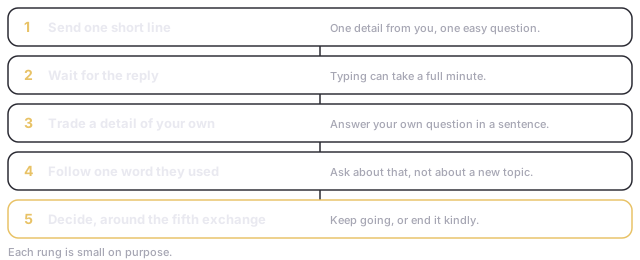
The 5 steps behind every row
- Send one line, not two.
- Wait. Some people need a full minute to type.
- Answer your own question in a sentence, so the trade stays even.
- Follow a word they used, not a new topic. A reply like "sure, talk to me" means go ahead.
- Around exchange 5, decide: keep going, or end it kindly.
Talk with me: ask for a listener, or ask for advice
Most people who search talking to me want company first and answers second. Chats about a bad day usually fail on one missing sentence: the speaker wanted an ear and the listener offered a plan. A stranger cannot guess which you need, so say it first. "I do not need advice, I need someone to hear this" works. So does "I am stuck and would love ideas." Flip it when you listen. If someone writes "talk with me for a minute", ask one question before anything else: ideas, or just company? Then do what they chose.
Small habits make you good company:
- Ask follow-ups. Huang and colleagues reported in 2017, across 3 studies plus speed dating, that people who asked more follow-up questions were better liked.
- Let their story finish before you tell yours.
- Leave a pause alone. Quiet is not an emergency.
Topics that open people up, and mistakes when talk stalls
What and how questions open people up. In our experience these work: a small win from this week, a favourite with a story behind it, a free Sunday with no plans. Stalls come in 3 kinds. For one-word answers, offer 2 lines of your own, then ask something different. For silence, wait longer than feels comfortable, then say no rush. When you run dry, change the track on purpose. Never rescue a quiet moment with 3 questions in a row. A flat chat says little about you, so thank them and try again.
Using this free chat to practise
Here the setup is a nickname and a choice between typing and speaking; the person on the other end is 1 adult you have never met, and there is no account, download or video. Wondering who is talking to me tonight? Nobody you chose, which is the point. If a pairing does not click, Next moves you on.
Prefer your own company? Make a private room with a name (letters and numbers, at least 3 characters) and a password of at least 8, confirm you are 18 or over, and pass the invite link to whoever you want. Up to 5 people fit in one room, in text or voice. We never match by location.
Adults only: if you are under 18, close the tab. Our house rules list what is off limits.
Questions about getting someone to talk
Getting started
- Is it normal to want someone talking to me when I feel flat?
- Yes. Wanting conversation is as ordinary as wanting lunch, and you need no dramatic reason. The WHO figure above shows how many people feel the same. Take it as a nudge to reach out.
- What if I have no idea what to say first?
- Pick any row from the table and send it unchanged. A borrowed line beats a perfect one you never send. Once they reply, you are only continuing, and that is much easier.
- How long should I wait for a reply?
- Give a text chat a full minute before you wonder, and resist a second message just to fill the gap. If nothing comes for a long while, write one friendly line or move on.
- Can I speak instead of typing?
- Yes, voice is offered next to text, and it suits people who type slowly. The same rules hold: start small, ask follow-ups, leave pauses alone. Our voice-first comparison goes deeper.
When the chat is hard
- How do I ask someone to just listen?
- Say it before you begin: "I do not need advice, I just need to say this out loud." Share a little, then check they are happy to hear more. That saves the listener from guessing.
- Why do replies come back so short?
- Usually it is not about you. Some people type slowly, some are shy, and some are doing 3 things at once. Try a lighter question, share a detail of your own, and give it a few exchanges.
- Should I tell a stranger what is bothering me?
- You can share a feeling without identifying details. Leave out your full name, workplace and address. A stranger can listen well for one evening, but a chat is company, not ongoing support.
- Is it rude to end a conversation?
- Not if it is kind. One line is enough: "I enjoyed this, I have to go, take care." A short goodbye beats silence, and with a stranger there is no friendship at stake.
Beyond the chat
- How do I get a friend or relative to talk to me more?
- Choose a calm moment and ask for a specific amount: "Could we talk for 10 minutes after dinner?" Say what you want, a listener or ideas, and ask one real question about their day first.
- My partner will not talk with me. What can I say?
- Skip the accusation. Try: "I miss talking with you. Could we set aside a little time this week?" Name the feeling, make a small request, and let them pick the moment.
- What if I get nervous and my mind goes blank?
- It happens to everyone. Keep 2 backup lines ready, such as tea or coffee. If you blank, say so with a smile: "I just lost my train of thought, what were you saying?"
- When should I look for real support instead?
- If the heaviness lasts, if chats leave you lower than before, or if you feel unsafe or hopeless, a trained person is the right door. Our crisis help page lists services you can reach now.
For what a stranger is good for, read I want to talk to someone. If nerves are the obstacle, try the guide to talking to strangers. For looser talk with no goal, there is the chit-chat page.
Sources: the World Health Organization's release on social connection for the loneliness figures and the Chicago Booth summary of the commuter experiments for the commuter findings.