Chit chat: what it means, and seven openers you can use word for word
What is chit chat, exactly? It is light, low-stakes talk about things that do not matter much: the weather, the queue, the song playing overhead. Cambridge Dictionary calls it informal conversation about matters that are not important, and offers small talk as the synonym. The subject is never the point. The point is the small friendly signal sitting underneath it.
Most people typing chit chat into a search box are not shopping for an app. They want the words: what to open with, what to say when the reply is two words long, and how to stop before it goes flat. So this is a script sheet.
The panel above puts you in front of one adult stranger, typing or speaking, with nothing to install and no sign-up. Somewhere to practise chit chat and watch what comes back. Everyone here is 18 or older.
What chit chat means, in two dictionaries
Two dictionaries sit inside the first five results for this phrase, which tells you plenty about who is searching it. Cambridge defines chit chat twice: as a noun meaning informal conversation about matters that are not important, and as a verb meaning to talk informally about those same unimportant matters. Merriam-Webster is blunter, giving small talk and gossip. Its entry records the origin as a reduplication of chat and dates the first known use to 1688. The phrase is around three and a half centuries old, and has meant the same modest thing throughout.
The verb form does more work than it looks. Cambridge lists that sense as ordinary usage, with examples about talking of this and that. It is something you do, not something you own. Nobody prepares chit chat in advance, and nobody finishes with a result.
Chit chat and small talk are not quite the same thing
Debrett's, in an everyday etiquette guide written with Britain in mind, draws a line that most writing on this subject skips straight past. Chit chat is the most basic form of small talk, it says, and it is an end in itself: the exchange with a shop assistant, the hairdresser, a stranger at the gym, whose entire purpose is to make the moment easier. Small talk proper, the kind practised at a dinner or a drinks party, can be the opening move in an acquaintance that ends in friendship or romance. One is a door. The other is a doorstep, and it is perfectly content being a doorstep.
What the distinction changes about an opener
That changes what an opener has to do. If chit chat is an end in itself, a line demanding a real answer is too heavy for it. Nobody is being auditioned. You are offering thirty seconds of ordinary human noise, and the honest measure of success is that neither person felt awkward.
Seven chit chat openers you can use word for word
Each is a complete first message. Copy one, or change a detail so it is true for you. They all run the same way: hand over one small concrete thing, ask for one back.
- “Is it doing anything dramatic outside where you are? It has been raining here since Thursday.” Debrett's names weather the universal ice-breaker, and it excludes nobody.
- “That bus took forty minutes to go four stops. Please tell me your day travelled better.” Transport is the other universal topic, and a shared grumble bonds strangers fast.
- “Settle something: is a plate of leftovers reheated at midnight a meal or a mistake?” Everyone can answer a food question, and most enjoy defending the answer.
- “Currently four episodes into a show that is not even good. What are you watching that you would actually defend?” Gives your own answer first, so no confession is being demanded.
- “It is Friday somewhere. What is the smallest good thing you have got planned?” Weekend plans, with the bar low enough that a quiet week still answers.
- “Best sight of the week here was a man carrying a full-size door down the street. Beat that.” An odd anecdote invites one back, and it is playful rather than nosy.
- “Neither of us knows a thing about the other. What can you see from where you are sitting?” Uses the blank slate instead of pretending it is not there.
What to send after they reply
The opener is the easy half. Most chit chat dies in the second message, and the move that keeps it breathing is smaller than people expect: take one noun out of their reply and ask about that noun. If the rain has wrecked their washing, you do not need a new topic, you need the washing. This is why a list of topics is less useful than it looks. Almost nobody stalls for want of subjects. They stall because they answered, waited, and got a fresh unrelated question back, which reads like a form.
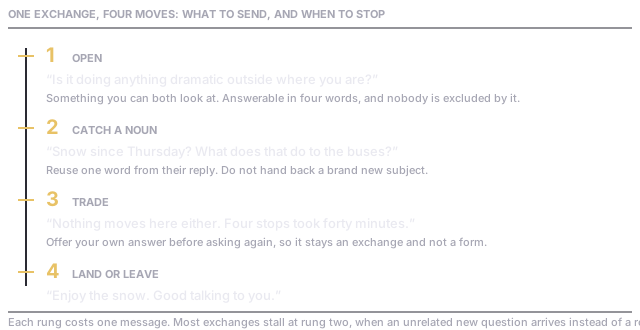
Ending well is half the craft and hardly anybody practises it. Debrett's advice is to know when you are beaten: if somebody does not want to talk, you cannot make them, and the right move is to go without reading it as a verdict. A one-line exit costs nothing. Thanks, enjoy your evening, gone.
Chit chat topics that travel, and where each one stalls
Six chit chat families that work with somebody you know nothing about, a line for each, and the moment to let it go.
| Topic | A line that opens it | Why it travels | When to drop it |
|---|---|---|---|
| Weather | “Anything dramatic happening outside?” | Named as the universal ice-breaker | The moment it becomes a forecast |
| Transport | “How long did anything take you today?” | A shared grumble is a fast bond | If they have not left the house |
| Food | “What did you eat last, and was it good?” | Everybody has both an answer and a view | Once it turns into a recipe |
| Watching | “What is on your screen when you are not here?” | Asks for a recommendation, not a fact | If neither of you knows the other's |
| Plans | “Anything decent coming up, however small?” | Low bar, so honesty is easy | On a Tuesday, with nothing to report |
| Your room | “What can you see from where you are?” | Needs no shared world at all | If the honest answer is a wall |
Weather, transport and weekend plans are named as reliable topics by the etiquette guide cited below, read on 6 September 2026. The other three families, and every line here, are ours.
Six rules that keep chit chat pleasant
Debrett's sets out the etiquette better than anything else we read, and all six below are its rules rather than ours. They read fussy on paper and turn out practical.
- Reinforce, do not argue. It is a positive interaction by design, so a comeback breaks the form even when you happen to be right.
- Sixty seconds is the ceiling. Talk uninterrupted for longer, says Debrett's, and you have been talking too long.
- Do not be nosy. Marital status, family, finances and politics are the named no-go questions between strangers.
- Ask something back. Questions keep it a rally. A rambling monologue turns a stranger into an audience, and audiences leave.
- Start smaller than feels useful. A warm good morning is a full move. An opener needs to be easy, not clever.
- Know when you are beaten. Some lines fall on stony ground. Move on, and do not carry it into the next conversation.
Chit chat with a stranger you will never meet again
Doing this online takes away the two things that make it hard in person: you will not see them tomorrow, and no room is listening. That changes the arithmetic completely. A line that lands badly costs you nothing, so you can try the one you would never risk on a colleague. It also takes away the props. There is no shared queue, no weather you can both look out at, no room to remark on, which is exactly why the openers above lean on what each of you can see from where you are sitting.
We built this site for that kind of chit chat and nothing heavier. One adult at a time, typing or speaking, with no account, no profile and no camera at any stage. Our guide to talking to people you have never met covers the nerve of it more broadly, and if you arrived from the brand sharing this phrase, the four products answering to that name untangles which is which.
Two habits keep it safe as well as enjoyable. Keep your full name, address, workplace and money out of it, and treat any push to move somewhere private as the end of it. Our house rules draw the line, and a report is read by a person.
If the word anonymous is the part you care about, what it does and does not cover is worth five minutes, and the spoken version of all this explains what changes when you say a line instead of typing it.
Questions about chit chat
The phrase itself
- What does chit chat mean?
- Cambridge defines it as informal conversation about matters that are not important and gives small talk as the synonym. Merriam-Webster shortens that to small talk and gossip. Both describe chit chat as talk whose subject is the least important part of it.
- Where does the word come from?
- Merriam-Webster records it as a reduplication of chat and dates the first known use to 1688. The word is literally chat said twice, a fair description of the activity as well as of the spelling.
- Is it a noun or a verb?
- Both, and Cambridge lists both. As a noun it is the thing you had; as a verb it is the thing you did, which is why chit chatting turns up about as often. The verb is the more useful half.
- Is it the same as small talk?
- Not quite. Debrett's calls it the most basic form of small talk and, importantly, an end in itself, whereas small talk at a dinner can be the opening move in an acquaintance that goes somewhere later.
Doing it well
- What is a good opener with a complete stranger?
- Something answerable in four or five words that neither flatters nor interrogates. The seven scripts above run on one engine: hand over a small concrete fact, ask for a small concrete fact, so saying yes costs nothing.
- How do you keep it going past the second message?
- Take a single noun from their reply and ask about that noun. Nearly every stalled exchange stalls because somebody answered a question and received an unrelated new one, which feels like being processed rather than talked to.
- How long should it last?
- As long as both sides enjoy it, and not a message longer. Debrett's offers one hard limit worth keeping: talk uninterrupted for more than sixty seconds and you have been talking too long.
- What should you not bring up?
- Debrett's names marital status, family, finances and politics as questions strangers should not be asked, and that holds online too. Add anything identifying either of you, since the anonymity is what makes the exchange easy.
Practising here
- Do you need an account to practise?
- No. There is no sign-up, no email address and no password, and the nickname you pick lasts exactly as long as the conversation. Nothing is built that anybody could look you up on later.
- Can you do it out loud instead of typing?
- Yes. Say so at the start and the pairing is made by microphone rather than keyboard, so the whole exchange happens aloud, with no camera at any stage. Anyone who would rather type is never matched into a call.
Adjacent questions worth a minute: picking a language before you start typing, then choosing between a stranger, a friend and a professional.
If an opener lands and you want somewhere to use it, text and voice with the video left out and a chat that never asks you to sign in both start in one tap.
Last verified: 2026-09-07
Sources we leaned on, and what each one settled: Cambridge's entry for the noun and verb senses, Merriam-Webster's entry for the etymology and the 1688 date, and Debrett's guide to the art of it for the etiquette and the universal topics.