Tinychat puts you in a room with an audience. We pair two people, alone.
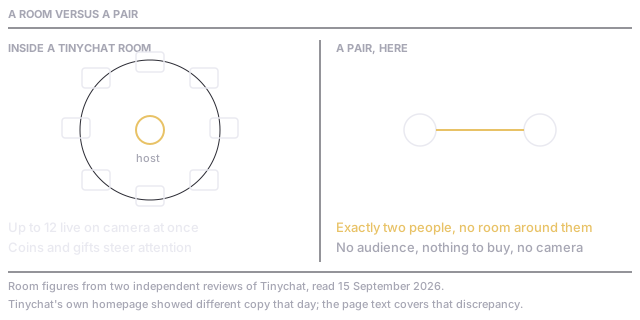
Tinychat is a group video chat site: strangers gather inside a room, not a pair, and up to 12 of them can be live on camera at once while others watch or type alongside. That is a genuinely different shape from the one-to-one pairing this site runs. This page works through what a room actually changes: who is watching, what a paid credits system does to a conversation, and what a pair gets by having no audience and no room to manage.
If a webcam and a room full of people is what you are after, Tinychat is built for exactly that, and we are not going to pretend otherwise. This site runs no camera at any point, text or voice only, and there is no room to walk into, ever. If that is the whole point for you, go there.
Enter any nickname above to begin. It opens in this tab, asks for no account, and pairs you with exactly one adult, nobody else watching. 18 and over.
What Tinychat actually is, before anything else
Tinychat has been running since 2009, per one review we read, which makes it one of the older names in this category rather than a recent entrant. The product itself is a room: a named, browsable space a host runs, where anyone inside can broadcast video, audio, or just text, and everyone else in that room sees it at once, live.
We opened tinychat.com's own homepage twice today, 15 September 2026, hoping to quote its current claims directly. Both times it showed marketing copy describing a one-to-one "swipe and match" roulette with a Next button, not a room, language that does not match what two independent reviews, read separately, both describe. Rather than pick whichever version reads cleaner, this page leans on those independent accounts and says so here.
A room has an audience. A pair never does.
The single biggest structural difference is who is watching while you talk. Step into a Tinychat room and, per the reviews we read, you might be one of up to 12 people broadcasting at once, in front of everyone else in that room, whether they are broadcasting back or only watching. A conversation inside that room is, functionally, a small performance: what gets said is shaped by who else is in the audience, not only by whoever you are replying to.
A pair removes the audience entirely. Here, it is one person and one other person, and nobody else ever sees or hears either side. Nothing said in that pairing is being watched by a room, because there is no room. That changes what gets said, not only how it gets delivered.
What the credits economy turns a conversation into
Tinychat runs a virtual currency and gifting system on top of its rooms, per two reviews we read: people buy or earn coins, send gifts to a host or to someone else in the room, and build up points that unlock a status icon next to a username. A Gold subscription, priced at $25 a month per one review, adds the ability to create up to 5 rooms and a monthly coin allowance; an Extreme tier sits under that at $5 a month.
That system does something specific to a room's social dynamics: attention becomes something you can buy, visibly, in front of everyone else present. A host with more gifts is more visible, and a whole room can be promoted toward the top of a live directory for a stated 500 coins, per the same review. None of that is a failing on Tinychat's part; a gifting economy is a legitimate way to fund a free room-hosting product. It is simply a different social contract than two strangers talking with nothing to buy and nobody ranked.
What a room adds, and what it costs you
Set side by side, point by point, a room and a pair trade very different things for very different reasons.
| What changes | Inside a Tinychat room | Inside a pair, here |
|---|---|---|
| Who can see you | Everyone in that room, up to 12 broadcasting live at once, per two reviews | Exactly one person, never more |
| What buys attention | Coins, gifts, and a Gold subscription, with a status icon to show for it | Nothing; there is nothing to buy |
| Who runs the space | A named host, who can hold up to 5 rooms on the Gold tier | Nobody; no rooms exist to hold |
| A space to come back to | The room itself, with its own directory listing | None; there are no rooms or profiles here |
| Account | Recommended, via email or Facebook; guest access is limited | None, ever, for anyone |
| Age floor | 18 and over, per one review | 18 and over, no exceptions |
| Camera | Central to the product; broadcasting is the point | None, ever. Text or voice only |
| Cost | Free tier, plus Extreme at $5 a month and Gold at $25 a month | Free, with no tier of any kind |
Tinychat column drawn from two independent reviews of the platform, read 15 September 2026, not from our own use of the product.
Three names that are not tinychat.com, on the same page of results
We ran a search for tinychat from an India location on 15 September 2026 and read all 7 results in order, not only the first one. tinychat.com itself holds position 1. Position 2 is tinchat.me, a separate brand with nothing in common beyond the near-identical spelling: it is a one-to-one video chat product run by a company called Innovate Beyond B.V. out of Amsterdam, and nothing on its own page mentions tinychat.com at all. Worth reading carefully before typing either address, since one missing letter lands you on a different company's product.
Positions 3, 4 and 5 are pages other sites publish about Tinychat rather than pages Tinychat runs itself: a comparison entry on strangercam.com, an alternatives page on talkrand.com, and a review on coomeet.chat titled as an alternative. Position 6 is the brand's own Facebook page. Position 7 is the sharpest collision on the list: a listing on softwaresuggest.com for a product also called Tiny Chat, which is, by its own description, live chat software a business installs to talk to its own website visitors, priced from roughly ₹900 a month. That is an enterprise support widget, not a video chat product, and it shares nothing with tinychat.com except the two words in its name.
Three steps to start chatting here
The version of this that never asks who is watching.
- Type a nickname. No room, no directory listing and no audience, just a name for whoever you are paired with to reply to.
- Settle the medium: typing, or talking. Talking means a live, audio-only call, decided before you connect and never switched to video.
- Press start. You are placed with exactly one person from the same pool everyone else is in, with nothing to buy and nobody else watching.
Questions about Tinychat's rooms and credits
- How many people can actually be in a Tinychat room at once?
- Per one review we read, a room supports live broadcasting from up to 12 people simultaneously, a limit described as necessary to keep video quality from dropping past that point. Beyond those 12, more people can still sit in the same room reading and typing in text, so a room's total size runs well past its camera limit.
- Does Tinychat cost anything to use?
- There is a free tier, per the reviews we read, sitting alongside paid Extreme and Gold subscriptions priced at $5 and $25 a month. The paid tiers add ad removal, higher video quality, more rooms to create, and a monthly allowance of the coins its gifting system runs on.
- What do the coins and gifts actually buy inside a room?
- Status, mostly. Gifts sent to a host or to someone else accumulate into points that unlock a visible icon next to a username, and enough coins can push a whole room toward the top of Tinychat's live directory, reportedly for 500 coins. None of that changes who you are matched with, only how visible you are once you are there.
Questions about the name collisions
- Is tinchat.me the same company as tinychat.com?
- No, based on what its own page says. tinchat.me is a separate one-to-one video chat product, run by a company called Innovate Beyond B.V. based in Amsterdam, and its homepage makes no mention of tinychat.com or any relationship to it. The two names differ by a single letter, which is the whole reason to check the address before typing it.
- Is the "Tiny Chat" listed on SoftwareSuggest the same product as tinychat.com?
- No. That listing describes live chat software a business installs on its own website to talk with visitors in real time, priced from roughly ₹900 a month, which is an enterprise support tool. tinychat.com is a consumer group video chat site with rooms and a gifting economy. The two happen to share a name and nothing else.
- Do the pages other sites run about Tinychat outrank Tinychat's own page?
- Not in the 7 results we checked; Tinychat's own Facebook page held position 6, ahead of the softwaresuggest listing at 7. But 3 of the 7 results, at positions 3 through 5, are pages competitors publish about Tinychat rather than pages Tinychat runs itself, worth knowing before treating any of them as the brand's own word on itself.
Questions about voice, audience and who is behind each site
- Is a spoken conversation possible here, without a room?
- Yes. Choosing audio puts you into a live spoken call with one other person, camera-free throughout, with no room and no audience around it. More on spoken pairing sits on the audio chat page.
- Is there an audience here the way there is in a Tinychat room?
- No. A pair here is exactly two people for its whole length; nobody can join to watch, and there is no room to walk into. Our note on what anonymous actually covers looks at a related question, what having nobody watching is worth on its own.
- Is talk2strangers connected to Tinychat in any way?
- No. talk2strangers is its own operation, unaffiliated with tinychat.com, tinchat.me, or any other name mentioned above. They are described here so that someone choosing between a room and a pair knows what each one actually asks for and shows, before committing to either.
Where to look next
The audience question shows up in a different shape on what Bazoocam's own geolocation claim actually decides for you and on what Joingy's next button rewards before anyone has said a word. Directory-style listings for this whole category get their own look in our note on the TalkWithStranger directory.
If a conversation anywhere, room or pair, turns into something heavier than either site is built to handle, the crisis support page has numbers staffed around the clock.
Rooms split by language rather than by host are the subject of the Chat2Friends room list, read room by room.
A coins-and-gifts economy is not unique to Tinychat's rooms either - LivU runs its own version on top of one-to-one video calls instead of a room.
Every room-based service we have read is compared on our chat room page.
Last verified: 2026-09-15
Sources read while building this page: tinychat.com's own homepage, opened twice on 15 September 2026 though its current marketing copy did not match the independent accounts below, an independent review of the platform for its broadcast limit, subscription pricing and coin figures, a second independent review for its founding date and room-ownership details, the SoftwareSuggest listing for the unrelated B2B product sharing its name, and tinchat.me's own homepage for confirming it is a separate product.