The number 1 search result for vidizzy is not vidizzy.com
Vidizzy is a real video chat site: no account, no app, a one click start. But the number 1 India search result for its own name is not vidizzy.com. It is a Play Store listing whose install button, per the package id printed in its own address, opens something else entirely. This page checks that listing the one way that actually works: reading the string, not the title.
No camera runs here, at any point, ever. Text or a voice call, a nickname typed into the box above, and nothing else asked. Adults only, 18 and over.
What Vidizzy actually is, verified from its own homepage
We opened vidizzy.com directly on 15 September 2026 rather than trust a summary of it. Its own front page describes a free video chat that needs no account and no install: you are told plainly that you don't have to create an account or install any app, and that a single click starts the call. Age is set with a dropdown running 18 to 70, and the page states that no phone number or email address is ever asked for.
What a competitor's write-up adds
The same page states that over 25,000 people use vidizzy every day. A competitor's own write-up of the product, read separately below, repeats a near-identical daily figure and adds detail vidizzy.com does not state itself: a launch date of November 2023, an operator it names as yaBeat Entertainment Inc., and a reach across more than 50 countries. We could not confirm that operator name or launch date beyond that one account, so both are presented here as a third party's claim, worth reading, rather than a fact we checked directly ourselves.
Reading the India search results, position by position
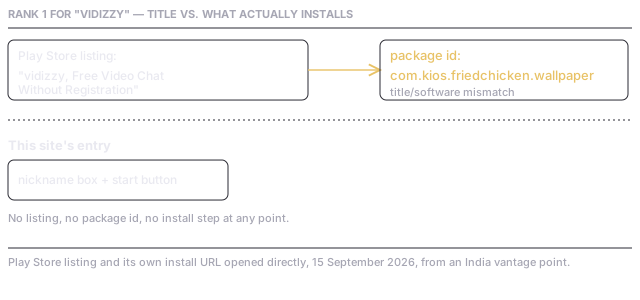
Type vidizzy into a search box from India and the page that answers first is not the one above. It is a Google Play listing titled "vidizzy: Free Video Chat Without Registration," which reads, on its title alone, like exactly the right result. Its own address tells a different story.
The listing's own URL carries the parameter id=com.kios.friedchicken.wallpaper. That string names fried chicken and a wallpaper, and nothing about video or chat. A package id is the one label on a store listing that a title cannot spoof on its own, because the id is also the address the store uses to actually install something once you tap the button, and this particular one points at software carrying no stated connection to Vidizzy at all.
We are not claiming the software behind that id is harmful, only that its own name string does not match the title sitting on top of it. Whether that gap is a spoofed listing, a mislabelled one, or a search engine indexing error is not something a package id by itself can settle, and this page does not attempt to settle it either. What it does settle is narrower and still worth having: the number 1 ranked result for this name is not, on the evidence of its own address, Vidizzy, whatever the title sitting on top of it claims.
What a package id actually tells you
Every Android app carries one id, set once by whoever built it and left unchanged afterward, because the store uses it as that app's permanent address. A title and an icon can be edited at will. The id sits inside the install URL and rarely gets a second look, which is exactly why it is the more useful of the two to check before a tap you can't easily undo.
Reading one takes seconds: open the listing, find the text after id=, and ask whether the words inside it resemble the words in the title above them. On the vidizzy listing they do not. On a genuine listing for a video chat product, the id string usually contains something recognisably close to the product's own name.
The rest of page one: two write-ups and a vendor demo
Positions 2 through 4 are not vidizzy.com either, and each is a different kind of page. Position 2 is coomeet.chat's own "Vidizzy – Alternative" page, a competitor's write-up rather than the product's own site. Position 3 belongs to trtc.io, a developer tools vendor whose page uses Vidizzy as a worked example of what its own product could build, stating outright that with its solution "you can easily build a similar engaging social experience," not a description of Vidizzy's own team. Position 4 is strangercam.com's comparison page, another competitor's account rather than a first party one.
Between the two competitor write-ups, the picture of Vidizzy that emerges lines up with what vidizzy.com says about itself: free to use, no signup, an age dropdown running 18 to 70, and a browser tab rather than a download. One of the two adds detail vidizzy.com does not state on its own front page, including six listed languages and a webcam requirement for the video mode, both attributed to that write-up rather than confirmed on vidizzy.com.
Six checkpoints, Vidizzy against a nickname box
Set the mismatched listing, the real product per those third-party accounts, and this site side by side.
| Checkpoint | What the #1 result actually is | What Vidizzy actually is, per third-party accounts | Here |
|---|---|---|---|
| Package id in the store address | com.kios.friedchicken.wallpaper | Not documented on the mismatched listing at all | No id exists, because nothing installs |
| What tapping install gets you | Whatever that id string actually launches | A browser-based video pairing, per one account, running since 2023 | A text box already loaded in this tab |
| Camera | Unclear; the title promises video, the id says wallpaper | Required for the video mode, per both write-ups read | None, ever, at any point |
| Age at entry | Not stated on the mismatched listing | 18 to 70, self-declared, per vidizzy.com's own setup screen | 18 and over, with no ceiling asked |
| Registration | Not stated on the mismatched listing | None, per vidizzy.com and both accounts read | None. A nickname, and nothing past it |
| How you verify it | Read the id string yourself before tapping install | Match that id against yaBeat's actual listing, not this one | Nothing to verify. No second address exists to confuse this with |
Read from vidizzy.com, from the coomeet.chat and strangercam.com write-ups named above, and from the mismatched listing's own address, on 15 September 2026.
Why a nickname here needs none of this checking
Everything above is a fair amount of work for one search term, and none of it is unusual. Every install carries the same shape of risk: a title you can read in under a second, and an id string that takes a deliberate second look most people never give it. That gap is the trade a phone makes every time it puts a new icon on a home screen, and it is not a flaw specific to this one listing.
A browser tab skips that trade entirely. There is no listing to open, no id to read, no icon that could belong to something else, and no download to have gotten wrong. Typing a nickname into the box above and pressing start is the whole entry procedure, with no second address anywhere for it to be confused with.
A one-tap report sits inside every chat here, with no menu to dig through to find it. Adults only, 18 and over, with no area on this site for anybody younger.
How to get into a chat here
No listing, no id, no waiting on a store page to load. The whole procedure, start to first message.
- Type any nickname into the box above. Nothing else is asked, and no field runs longer than that one.
- Settle typed or spoken before anything loads. Spoken is a live call, camera-free at every stage, fixed before you connect.
- Tap start. Exactly one stranger is paired with you and you can type or speak right away, with next there whenever a different pairing is wanted.
Questions about Vidizzy and the mismatched listing
- Is Vidizzy a real, working video chat site?
- Yes, per its own homepage. Vidizzy describes itself as a free video chat with no account and no install, states an age range of 18 to 70 at entry, and a third-party write-up of the product independently repeats a near-identical daily user figure, which is the kind of overlap a fabricated listing does not usually earn on its own.
- Is the number 1 result for this name actually dangerous?
- That is not something a package id alone can prove either way. What the id shows is a mismatch between the listing's title and the string naming the software behind it, which is reason enough to skip that result and go to vidizzy.com directly rather than to conclude anything stronger about intent from a string alone.
- Who is behind Vidizzy?
- One third-party write-up names an operator, yaBeat Entertainment Inc., and dates the product to November 2023. We read that claim on a competitor's own page rather than on vidizzy.com itself, so it is presented here as their account of the company, not a fact independently confirmed on Vidizzy's own site.
Questions about verifying any app before you install it
- What is a package id, in plain terms?
- It is the permanent internal name a store uses to install an app, sitting inside that listing's own address after id=, and distinct from the title and icon a publisher can edit at any time. Reading it takes seconds and is the one check a spoofed or mislabelled listing cannot fake without changing the actual software sitting behind it.
- Does a high rating mean a listing is safe to install?
- Not on its own. A rating and its review count describe how existing installs felt about whatever they received, not whether the specific listing in front of you right now is the product its title claims to be, and a package id mismatch can sit underneath an ordinary-looking rating without ever affecting it.
- What should you do if a package id doesn't match the title above it?
- Close that listing and go to the product's own domain directly, typed into the address bar rather than searched for a second time, since searching again can return the exact same mismatched result. Vidizzy's own address is vidizzy.com, and typing it directly is the safer route into the real product.
Questions about chatting here instead
- Does this site have a camera or video mode?
- No, and it never will. Text is the default and a live voice call is the only alternative, with nobody's face on screen at any point, which also means there is no camera permission for a browser to ask you about before a chat starts.
- Do you need to install anything to use it?
- No. It runs in the browser tab you already have open, with a nickname typed into a single box and nothing else requested. There is no listing, no package id and no store page for this to be confused with, because nothing about it is ever installed.
- Is talk2strangers connected to Vidizzy?
- No. talk2strangers runs independently, with no relationship to vidizzy.com, coomeet.chat, strangercam.com, trtc.io, or the mismatched Play Store listing named above. Each is described here so a search for one name doesn't quietly end on the wrong result.
Sister checks on this site
One company, two products, one search term: the airG split is the same kind of check. Unmingle, a spelling nobody actually uses, runs it with no product at all behind the name.
Where to look next
Still weighing a camera-first brand against a plain pairing? Our look at what an international pitch like Bazoocam's actually decides for you runs a similar check on a different video-first name, and how a Chatspin filter trades speed for choice does the same for filters rather than a listing.
Group rooms and paid tiers get their own read in the gap between a group room with an audience and a pair alone, and a brand's own claims get tested the same way in what RandomChatPro's no-signup and filter claims hold up against. If a nickname-only entry matters more to you than any of that, our breakdown of what anonymous actually covers and the page on talking out loud instead of typing are the two worth reading next.
Similar look-alikes, each checked, sit together on our page about Omegle's successors.
Last verified: 2026-09-15
Sources cited on this page: Vidizzy's own front page for its registration, age range and daily user claims, a competitor's write-up of the product for the launch date, operator name, country count and language list, a second competitor's comparison page for its account of the webcam requirement, and the mismatched listing's own store address for the package id that does not match its title.