Chatting: a glossary of the three things this one word now means
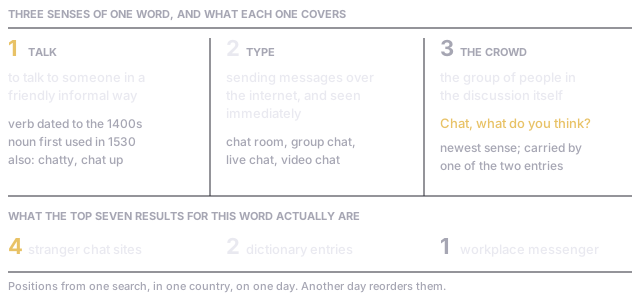
Chatting is informal talk, and the word now covers two quite different activities. The older sense is friendly conversation, spoken face to face or over a phone. The newer sense is a typed exchange carried over the internet, sent message by message. Both dictionaries ranking for this term list those as separate entries. A third sense, newer still, treats the chat as the audience reading along.
That spread is the interesting part, and you can see it without leaving the results page. Four of the top seven are places where strangers talk to each other. Two are dictionary entries for the word itself. One is a sign-in page for a workplace messenger. No single product sits behind the word, which is exactly why a glossary is more use here than a recommendation.
The box above is the entire entry step. Pick a name, press start, and one other adult is at the other end. Nothing installs, and no camera turns on. Over-18s only.
Where the word chatting came from
The dictionary sitting fourth in these results dates the verb to the 15th century. It puts the noun a little later, at 1530, and gives the origin as Middle English chatten, a clipped form of chatteren. Chatting therefore began life as a word for prattle, shortened from a word for chattering noise. The same entry still lists a bird sense, because chat also names several songbirds. Six centuries on, that entry has absorbed the internet without dropping anything, and chatted and chatting are still filed as the plain inflections of a plain verb.
Age explains a lot about the results page. A word this old, this short and this common attracts every product that involves two people exchanging words, and none of them own it. The dictionary entries are not stragglers in the ranking either. They sit there because a large share of the people searching want the definition rather than somewhere to start chatting.
Sense one: chatting as ordinary talk
Both dictionaries open with the offline sense, and one marks it beginner-level vocabulary. The definition given is to talk to someone in a friendly informal way. Its example patterns are chat with, chat about, and chat away, that last one glossed as talking eagerly. The noun follows the verb: a conversation, usually friendly and informal, as in idle chat or a fireside chat. There is an adjective too, chatty, for a person who does plenty of it. A business dictionary keeps the same sense and notes that chatting informally about work proved useful.
British usage adds a transitive form on top. To chat someone up is to talk to them lightly, glibly or flirtatiously, and the noun chat-up line follows from that. The sense never crossed fully into the online meaning, which is why a chat-up line still sounds spoken rather than typed.
Sense two: chatting as typing to someone
The internet sense arrived as a second numbered definition rather than a replacement. One dictionary phrases it as taking part in an online discussion in a chat room. The other phrases it as taking part in a discussion that involves sending messages over the internet, by smartphone or otherwise. A business entry is the sharpest of the three, defining online chatting by immediacy: you write, and the other person sees it straight away. That single condition separates chatting from email, and it is why a newsgroup was never described as chatting.
The collocations recorded under this sense show how far it spread. One entry lists chat service, group chat, live chat, online chat, video chat and chat group under a single headword. Related phrases in the other run to chat bot, chat line, chat room and chat show. A word for idle talk now labels support desks, gaming channels and family threads, which is exactly why these search results cannot agree with each other. Each of those compounds is younger than the verb by centuries. Online chatting grew a vocabulary of its own, and it borrowed the old word wholesale.
Sense three: the chat as the people watching
The newest sense is the one worth watching, and one of these dictionaries already carries it. It records chat as a countable noun meaning the group of people involved in the discussion, taking a singular or plural verb. Its own examples leave no doubt: our family chat mainly consists of memes, and, more tellingly, Chat, what do you think. The word has become a form of address. The other dictionary catalogues the idiom has entered the chat, defined as marking the sudden appearance of a person or a topic. Both are noun senses. Chatting, the verb, still points at the talk itself.
This is a live culture change, not a stylistic quirk. The sense grew out of watching a broadcast beside a scrolling message column, where a crowd answers back as one voice. It is also the sense a one-to-one pairing cannot serve, because there is no crowd to address.
One search for chatting, three different destinations
Seven results, measured on 6 September 2026 from an Indian English search for chatting. Grouped by what each one actually is, rather than by rank, they answer to three separate intentions.
| Rank | What the result is | Sense it serves |
|---|---|---|
| 1 | opentalk.club, a stranger chat site offering free text and video, no signup by its own description | Two |
| 2 | An app store listing titled Chat Rooms, Find Friends, which is a download page rather than a place to talk | Two |
| 3 | chatib.us, free chat rooms with no registration, wrapped in dating-advice teasers | Two |
| 4 | A dictionary entry for chat, giving the etymology, both noun senses and the bird | One, two and three |
| 5 | strangerline.io, a stranger chat site with text, voice, video and friend requests | Two |
| 6 | A workplace messenger sign-in, described by its own page as group messaging for work | Two, at work |
| 7 | A second dictionary entry, the one carrying the crowd sense and the business definition | One, two and three |
Titles and descriptions read from the cached pages themselves. Positions come from one search in one country, so a different country or a different day will reorder them.
Four checks before you start chatting anywhere
Sense two is where the chatting products live, and they differ far more than their front pages suggest. Four questions separate them quickly, in the order that decides the most.
- One person, or a room? A room carries an audience and regulars. A random pairing has neither, and the two do not feel remotely alike.
- What does entry cost you? Some ask only for a nickname. Others want an email, a phone number or a sign-in before your first message lands.
- Is a camera anywhere in the flow? Two of the sites here lead with video. This one has none at any stage, and that is deliberate.
- Where do the words go afterwards? Ask whether messages are stored, and for how long. Our privacy notice puts periods against that instead of adjectives.
More on each part of chatting here: what anonymous actually covers, talking out loud instead of typing, and what free tends to mean on a chat site. If rooms were what you wanted all along, our read on a large room-based service is the closer match.
Questions about chatting
The word itself
- What does chatting mean?
- Two things at once. Away from a screen it means talking to someone in a friendly, informal way, which is how both ranking dictionaries define it first. Online it means taking part in a discussion where messages travel over the internet and appear immediately.
- Is chatting a proper dictionary word or internet slang?
- It is an ordinary inflection of a verb first recorded in the 15th century, listed in the entry as chatted and chatting. The internet meaning was added underneath the older one rather than replacing it, so both are current and both are formal dictionary senses.
- What separates chatting from messaging?
- Immediacy, going by the business dictionary entry among these results. Chatting means the other person can see what you are writing straight away. Messaging tolerates a gap, which is why an email thread or a newsgroup was never described in those terms.
Chatting online, in general
- Why do dictionary entries rank for chatting?
- Because a large share of the searches are about the word, not about a product. Two of the top seven results on 6 September 2026 were dictionary entries, and a sixth was a workplace sign-in page. Only four were places to hold a conversation.
- Is online chatting the same thing as a chat room?
- No. A room is one shape online chatting can take, with several people present and everything typed visible to all of them. A one-to-one pairing is the other shape entirely. The dictionaries define the activity, never the layout it happens in.
- Does chatting include voice and video?
- One dictionary records video chat as a standard collocation, so chatting has stretched to cover it. Products vary widely. Two results here lead with video; this site offers audio and text, and adds no camera at any point in the flow.
Chatting on this site
- What does chatting here actually involve?
- One nickname and one other adult. You are paired at random, in text or in audio, with nobody else inside the conversation. There is no account, no profile and no download. Our house rules set out what is not allowed, and reports reach a person.
- Is voice different from typing here?
- Audio turns the pairing into a spoken exchange between two people, and you set that mode when you begin. No camera is involved at any stage. Speech carries pauses and emphasis that a typed line strips out, so the two modes feel quite different.
- Are you connected to any service named on this page?
- No. We hold no tie to any site, app or dictionary listed above, and none of them endorse us. They appear because they rank for this term, and because somebody comparing options deserves to know which of them is which. If a conversation ever turns dark, our crisis page lists help.
Elsewhere on this site: when a room beats a random pair, and when it does not, and the doors randomskip.com puts before a first message.
Two earlier attempts at untangling a name: what a subi chat search actually returns, and chatting now with no login in the way.
Brand names that point at more than one thing
The word chatting is not the only overloaded label. Each of these names sends a search to unrelated products at once, and each page sorts them apart:
- meetyou: a period tracker, a social app and a chat site under one search.
- chat airg: a farm game outranks the company's own chat app.
- Rabbit video chat: a live site, and a group-watch app that closed in 2019.
- ChitChat: four products, one of them a dollar wallet.
- chato: more than one product answers to it.
- live chat: support software, video apps and plain conversation.
- subi chat: a silent main site, an unrelated place name and an empty domain.
Last verified: 2026-09-07
Three pages carried the evidence for this one: one dictionary entry for the etymology, the 15th century date, the 1530 noun and the songbird sense, a second dictionary entry for the beginner-level definition, the online sense, the business definition and the crowd sense, and the workplace messenger sign-in for how it describes itself.